Sunday, 22 December 2019

Making The Timekeeper's Return: The Big Day


Printing and cutting out QR code stickers in preparation for the event

I told myself that I’d get at least 7 hours of sleep before the big day, but who was I kidding?

Instead I spent several hours printing and cutting out about 10 sets of 18 QR code stickers (I needed spares), as well as over 200 stickers with the astrolabe design on, as rewards for those who completed the treasure hunt.

In the end I think I got between 3 and 4 hours of sleep. This obviously wasn’t ideal, but I knew adrenaline would carry me through the day.

On the morning of 20th October I got into town at 7.50am, and the first thing I did was walk around the Cathedral Quarter and stick up the QR code stickers while there were as few people around as possible.

It was a good job I printed spare stickers, as I managed to stick one up in the wrong location at one point! Thankfully I realised what I’d done straight away and was able to replace it with the correct sticker.

After these early morning exploits, I had a bit of time to get some breakfast at McDonald’s and take things easy before the real work began.

The first task was to meet and prepare the three paid actors who the Cathedral Quarter and I had employed for the day.

Arranged by a contact of ours in the Canterbury Christchurch University Outreach team, the actors were there to facilitate the running of the game and, like the participating businesses, help forge a link between the past and present Cathedral Quarter and reinforce the participants’ sense of immersion in the narrative. Dressed in plain clothes, yet acting the roles of characters in the story, they became part of the ‘secret society’ that players entered into as they explored this part of the city.

The actors were briefed by me in advance of the event, which gave them a back-story to their character, some suggested lines they could use in different circumstances (e.g. based on questions they were likely to be asked, or problems that could arise during the game), and some key adjectives to describe how they should portray themselves in front of the participants. Everything else was open to improvisation.

On the day, I gave them all a tour of the relevant parts of the Cathedral Quarter too, to make sure they were aware of where the key locations were, and what to expect in the different sites.

Our first actor played the character of Mia Augustina’s research assistant, Rose, who stood at the starting point for the treasure hunt at the compass in Longmarket Square. Her job was to introduce herself to those who had turned up to take part, present them with the opening QR code, and provide guidance on installing a QR code scanner, how to scan QR codes, how long the treasure hunt would roughly take to complete, and any other general information about the event.

Rose positioned at the compass in Longmarket Square, where the treasure hunt began

Then there was another assistant, Max, who was asked to float around Burgate and the Buttermarket where some of the early points of interest were. She was on hand to provide any guidance to participants who weren’t sure what they were supposed to be doing, were lost, or were having problems with mobile internet coverage.

Finally, there was Mia Augustina herself, who was positioned at the end point of the treasure hunt. As well as letting the participants know that they had finished, she was responsible for giving out the small rewards earned by each participant who completed the game, taking down contact information for those who wanted to enter the larger prize draw, and making a record of how many people finished the trail in total.

Once the actors had been fully prepared, I had another group of people to meet. Thanks to the brilliant people in the Media Arts department at Royal Holloway, I managed to enlist the services of a small student film crew to capture footage of the event (at very short notice!), as well as interview me about the process of making The Timekeeper’s Return and the story behind its inception.

After making sure that all the actors and businesses were fully set for the event’s start at 10 am, the film crew and I went to Antoine et Lili, where we had been given space to shoot the interview. Having set up the camera equipment, they hooked me up with a microphone and asked me questions such as “how did the event come about?” and “why Canterbury?” to prompt the monologues that would provide narration for the film.

Knowing how difficult it is to edit films filled with broken speech and hesitations, I did my best to make sure that my responses flowed clearly and steadily. Thankfully, we therefore didn’t have to do too many takes.

After the interview, we also decided to record a segment of me talking about digital storytelling while walking through part of the Cathedral Quarter. This proved much more difficult than we imagined, however, as Burgate was so busy with people (and occasional cars!) that it was impossible to get a clear run. In the end we moved to the slightly quieter Butchery Lane, but it still look us four or five attempts to get passable footage. The cobbles were also a unique hindrance because of how difficult it is to walk steadily on them while carrying a camera.
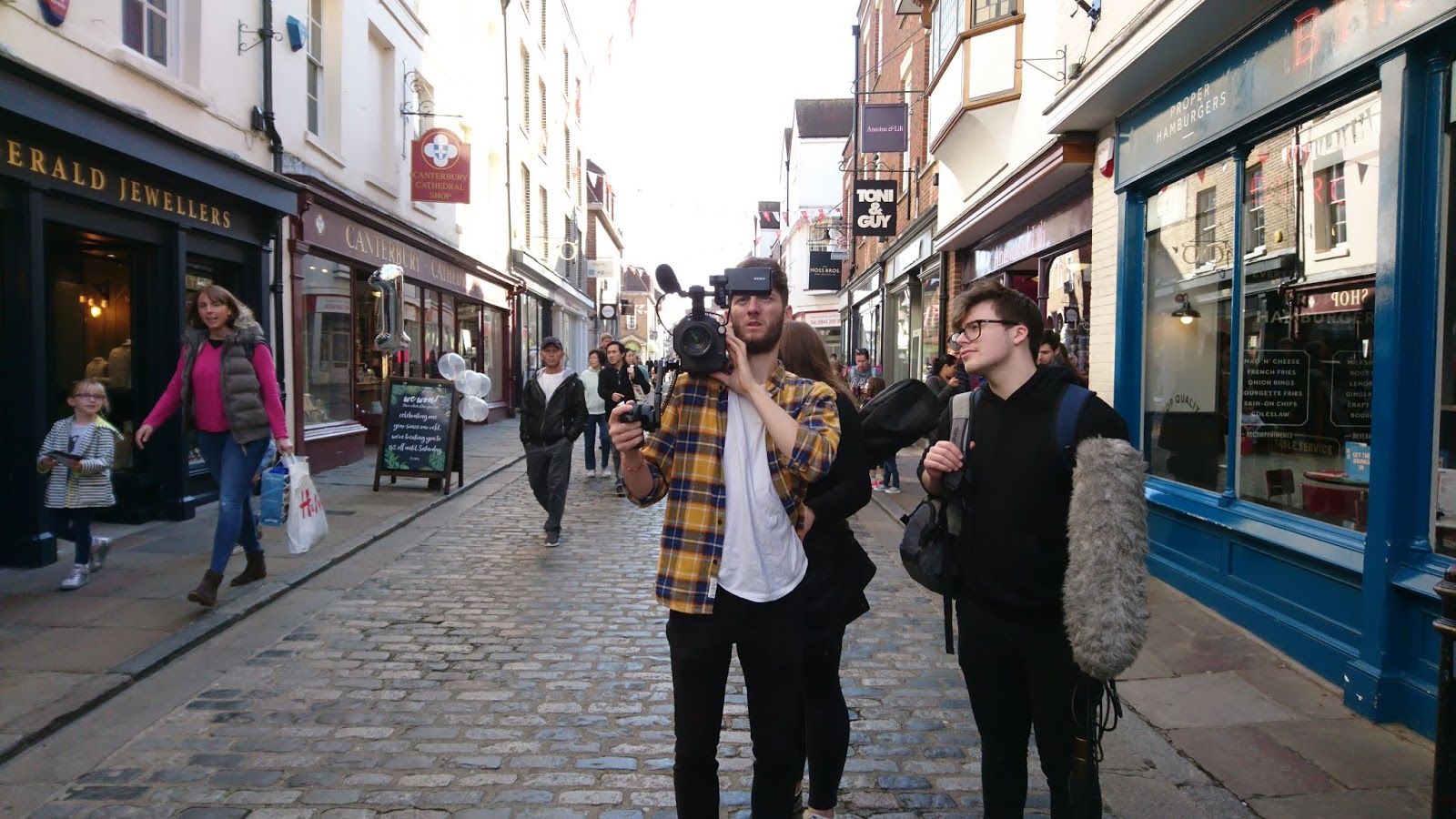
The film crew on Burgate

After the filming with me was complete, the crew went off to capture the game in action and to get some B-roll footage of the Cathedral Quarter.

Meanwhile, I set about checking in on all the actors and participating businesses, to make sure that everything was working without a hitch. I also visited all of the QR code locations, to ensure that all the stickers were still in place and intact.

Most of my time during the hours of the event was spent like this – running around like a headless chicken in my directorial role, to make sure that everything was running as smoothly as possible.

The wonderful cake made by the staff at Lakeland for The Timekeeper's Return, complete with the astrolabe logo

Participants read one of the story passages after scanning a QR code 

I did find some time to pursue other opportunities that came up during the day, and give myself some much-needed breaks.

At one point I met with another local artist, who I had connected with online as a result of advertising The Timekeeper’s Return on a mailing list. Then, later in the afternoon, I shared lunch and caught up with friends who had purposely travelled to Canterbury – some travelling quite significant distances – to try out the game I’d created and to support me.

It was very touching, and part of what made the day such a special one for me when I look back. It helped me to recognise how I wasn’t just a designer or director who had been brought in to run an event, but a valued part of these wider communities of artists, friends and local businesspeople.

A participant put a sticker with the event's astrolabe logo on her smartphone!

A gathering of participants

Though I was rushing around a lot on the day, on the whole it was apparent that everything was going remarkably well. Every time I entered one of the participating businesses, they remarked at how busy they’d been with people taking part in The Timekeeper’s Return, and how Burgate was buzzing with activity. I could see that myself just by stepping outside onto the street.

But as with all ‘live’ events, particularly those in public spaces, there are always unexpected occurrences that need to be negotiated. When the event is six hours long on a busy Saturday, as The Timekeeper’s Return was, the chances of unforeseen incidents only increase.

Of the few issues that did occur, nearly all of them were fairly mundane and easy to resolve quickly. At one point, I was informed that one of the QR code stickers became impossible to scan. Luckily, the people who first detected the problem were still at the site when I arrived, so I was able to replace it there and then for them with a sticker which worked properly.

I had also been made aware at one stage that a couple of groups of participants had struggled to spot one QR code in particular, and actually managed to skip it and move directly to one of the later QR codes in the story.

My solution simply involved talking to the businesspeople who were responsible for directing the participants at this stage of the treasure hunt, asking them to give a slightly clearer indication of the area where the next QR code could be found.

Perhaps the most concerning incident of the day came about an hour or two before the event finished.

I walked around to where the final actor was positioned at the end of the treasure hunt, only to find that I couldn’t see her anywhere.

The bag in which she kept all the rewards and sheets with contact details was still propped up against the wall where she had been positioned, but the actor herself was nowhere to be seen. Meanwhile, a group of street drinkers were playing music loudly from a nearby bench, to the bemusement of people passing by.

At first, I assumed that she might have just gone for a toilet break, and in the intervening time I filled in by taking on the persona of another one of Mia Augustina’s research assistants. For the couple of groups of participants I encountered, I congratulated them for finding all of the QR codes, explaining that Mia had already left to continue her research, but had left me with some gifts for those who had helped her return home.
          
However, after a little while someone from one of the nearby participating businesses found me to explain what had actually happened.

About ten minutes earlier, the street drinkers on the nearby bench had been swearing very loudly in front of the young children who were taking part. When my actor approached them and asked if they could tone down their language, they reacted very aggressively, threatening her and shouting directly in her face.
                   
When I spoke to her she was understandably quite shaken up, so I explained to her that I’d be happy to take over her role for the remainder of the event. In the end, though, she decided that she wanted to continue, and just needed a bit of time to regain her composure.
                                
Fortunately, when she returned to her role, the group of street drinkers had since moved on, and everything returned to normal.

Better than normal, in fact, as the numbers of players appearing before us only continued to rise. At one point, there must have been about 25 participants all gathered in the same place, having managed to reach that point of the treasure hunt at the same time.

A large group of participants gathers in the Cathedral Quarter

As the event drew towards a close, I saw a young girl walking the route of the treasure hunt with her dad. They still had a few more locations to visit before reaching the end, but the dad suggested to that they should leave early, as girl’s mum would be finishing work soon.

Clearly, this wasn’t what she wanted, and when the decision was finally made, she got upset and started crying.

Obviously I felt very sorry for her, though I couldn’t help but feel a flash of pride that the event and story I had designed had prompted that kind of emotional response. I had pitched the event as being accessible for all ages, but it’s always difficult to tell exactly how it will be received by different audiences. So it was especially rewarding to see younger participants getting so involved.

In the end, I approached them as they were leaving, and gave the daughter the rewards for finishing the treasure hunt anyway.

Once we were convinced that there were no more stragglers, the actors were free to leave, and I spent some time chatting with a couple of Cathedral Quarter businesspeople.

The overwhelming consensus was that the event had been a huge success, with over 200 people taking part and making the most of what the Cathedral Quarter’s built environment and independent businesses had to offer.

Beforehand, we were saying that we would be happy with half that number.

As the crowds dispersed, I said my goodbyes to those I knew who were visiting Canterbury for the event, and made my way around the Cathedral Quarter to remove the QR code stickers from their positions.

I then shared a celebratory drink with some of my local friends, and returned home completely worn out, but still glowing with an enormous swell of pride at what we’d achieved.

I think what strikes me most, looking back on the day of the event, are the very physical actions and materials that were necessary in order to make sure this ‘digital’ storytelling experience took place and ultimately was successful. From the posters and flyers that were printed in their hundreds, placed by hard-working volunteers on noticeboards, windows and other public displays across the Canterbury area, to the QR code stickers themselves and the surfaces to which they were stuck, the positioning and behaviour of the actors and participating businesspeople, and the smartphones through which the gameplay was largely mediated.

Furthermore, despite some unforeseen challenges on the day, overall we had some very good fortune. The weather remained stunning for the whole duration of the event; the technology stood up to the task (undoubtedly helped by the free WiFi offered by many of the Cathedral Quarter businesses); and the event was able to piggyback on the crowds drawn into the city centre for the opening day of the Canterbury Festival.

While we can certainly acknowledge these turns of fate, one factor that definitely cannot be overlooked is the commitment and hard work of those who offered their help to make The Timekeeper’s Return what we hoped it could be – the actors, businesspeople, testers, web and graphic designers, film crew, and everyone else involved in its production.

The Timekeeper’s Return aimed to foster a sense of community and shared heritage in the Cathedral Quarter, and it's lovely to be able to say that it is this combined effort of Canterbury people that comes to mind when I think back to this big, marvellous day.


The next and final post in the Making The Timekeeper’s Return series considers the feedback the event received, and its legacy.


Wednesday, 4 December 2019

Making The Timekeeper's Return: Marketing and Coverage


After the relevant changes had been made after testing, and the final QR code texts were ready to upload to the Cathedral Quarter website, the only thing left to do before the event was to continue promoting The Timekeeper's Return as far and wide as possible, with the limited time and budget we had.

Towards this end, I was fortunate to be able to get some invaluable advice from one of my former colleagues at Canterbury Connected Business Improvement District (Canterbury BID), who has worked very successfully in marketing for a number of years. She gave us very helpful tips on writing a press release, which I'd never done before, and how to approach media outlets with the story we wanted them to share.

Once we'd finalised what we wanted to say in our press release for The Timekeeper's Return, we sent it out to all the local news and events outlets we could think of.

As the big day drew closer, we managed to get the event featured in the Kentish Gazette newspaper, Muddy Stilettos (an online guide for local events and activities), the Visit Canterbury website, KentOnline’s What’s On page, promotional material for the Canterbury Festival, and communications to businesses and the public by Canterbury BID.

On social media, we reached out to local organisations and companies whose audiences we'd identified as overlapping with ours, including escape rooms, games societies, local history groups and family-oriented pages, some of whom agreed to share details of the event on their pages. This undoubtedly helped to snowball our engagement with our own target audiences.

Alongside local outlets, we used some of my academic connections to get the message out to people who I thought might find the event interesting conceptually, or who do research on this kind of media. This included promotion via the Royal Holloway social media pages for Geography and Media Arts, communications from research groups I’m involved in, and the Walking Artists Network email list.
             
You can see some of these features below:

Feature in the Kentish Gazette

KentOnline feature

Visit Canterbury feature

Muddy Stilettos feature

Social media was central to our strategy for reaching people who might want to participate. One of the advantages of using these platforms for promotional purposes is that you have the opportunity to tell stories that people interact can with, in a way that typical public notices don’t lend themselves to. 

In the process of doing research for the game, I came across so many small pieces of history about locations in the Cathedral Quarter that it would have been impossible to fit them all in. Furthermore, many of the locations or details themselves didn’t really fit into the larger story I wanted to tell, or I knew wouldn’t work well as points of interest in a treasure hunt.

So instead, after discussion with the Cathedral Quarter team, we decided to share these extra micro-histories in the week leading up to October 20th by creating a short ‘Cathedral Quarter Secret Facts’ series on the Facebook event page and the Cathedral Quarter’s social media pages.

Not only did this make people aware of the kinds of interesting facts they could discover by taking part in the event, but the content was thematically appropriate and primed those that saw the posts for the activity they would potentially be participating in – noticing details in their surroundings that might not be immediately obvious, and engaging with Canterbury’s historic past. 
                                                                        
Cathedral Quarter Secret Facts #1 on Facebook

Cathedral Quarter Secret Facts #2 on Facebook

Cathedral Quarter Secret Facts #3 on Twitter

Alongside the coverage in print and on social media, we produced hundreds of flyers and posters featuring my brother Sam’s superb graphic design for the project, which were displayed in local businesses, public amenities, and handed out at local schools. My sister Wendy was very adept at thinking of places that might accept them, and within a few days of the event there was barely a noticeboard or leaflet display in Canterbury that didn’t have our promotional materials for The Timekeeper’s Return.

A poster for The Timekeeper's Return on a Canterbury Festival bollard

The flyer reached noticeboards and leaflet displays all over Canterbury and beyond

This was further demonstrated when talking to members of the public on the day itself, who said that they’d seen the astrolabe iconography everywhere and had wondered what it was all about.

Thankfully, as one of the images above shows, we managed to find space on all of the Canterbury Festival bollards too. These are the four-sided stands plastered with event posters that appear in Canterbury’s busiest areas around the time of the festival, and are the one of the main ways that visitors to the city find out about what's going on.

Our hard work in marketing The Timekeeper’s Return certainly helped me feel hopeful in the days leading up to the event, but I couldn’t have predicted the turnout and reaction that we received on the day itself.


The next post in the Making the Timekeeper’s Return series recounts what happened on the day of the event.


Tuesday, 26 November 2019

Making The Timekeeper's Return: Testing

___________________________________

One year ago this autumn, I reached the culmination of an overwhelming three months of creative work and collaboration when I designed, wrote and directed The Timekeeper’s Return, a story-based immersive treasure hunt set in Canterbury’s Cathedral Quarter.

In this series of blog posts, I want to delve into the detail of how The Timekeeper’s Return was made, including an overview of how the event turned out on the day and the project’s legacy – for the participants, the Cathedral Quarter, and my own future as I continue to work in the area of location-based treasure-hunting games for my practice-based PhD.

___________________________________

Testing

The lead-up to the event was hectic and exciting.

In the month beforehand, I’d officially started the first year of my PhD at Royal Holloway, and had moved up to Egham where the main university campus is. So alongside finishing off the writing for the QR codes and promoting the event, I had to juggle induction events, first PhD supervisions, and settling into the place I’d be living for the rest of the academic year.

Inevitably, this meant that the writing took longer than it should’ve done, which reduced the time I had available to test the game itself.

Indeed, as it happened, I didn’t travel down from Royal Holloway to run a public testing session until Saturday 13th October – one week before the day of the actual event!

It obviously wasn’t my plan to leave testing so late. If there’s one thing I’ve learnt from talking and working with game designers of any kind, it’s that it’s never too early to start testing, and the more testing you do, the more potential problems you’ll be able to find and address before your game launches for real.

But in this case, not only did the whole event have to be devised from scratch and iterated on in a short space of time (less than 3 months), but my other commitments pushed my deadlines back further than I would have ideally liked.  

Thankfully, my testers gave some very helpful feedback that pinpointed aspects of my writing and design that I could fine-tune in time for the big day.

One outcome of the testing that I didn’t anticipate was how much it would boost my confidence in what I’d made. It was the first time the story I’d written had ever been aired publicly, and I was worried that the testers would find some fundamental flaws in the plot.

As it happened, the testers said that they found my writing style engaging, and when I asked the testers to summarise the story in their own words, their responses showed good comprehension of what I’d written. They freely mentioned parts that they particularly liked, and were often keen to share interesting details about Canterbury’s history that they’d learnt during the course of the test.

Another unexpected discovery from the testing was learning how difficult certain QR code stickers would have been to find.

In one example, my testers particularly struggled with a QR code I’d stuck low down on a bollard by one of the points of interest featured in the story. I was originally worried that its position might be too obvious – after all, the landmark in question was well-known to me. But what I failed to take into account was that the details testers had to notice were located far from eye level, and also faced the opposite way to the direction they approached the site from.

Of course, there was a balance to be struck too, because the event was a treasure hunt. If every sticker was easy to find, it would defeat the object of encouraging players to pay close attention to their surroundings.

So in the small number of cases where changes were required, in the end these only needed to be slight movements in where the stickers were placed. For the bollard example, this simply meant raising the height of the QR code so that when people spotted the relevant details in their surroundings, they almost immediately then found the sticker.

Aside from these positioning concerns, the testers observed that some of the QR code texts were quite lengthy and could do with being more concise; that there were a few typos; and that the wording in some of these texts needed to be a little more precise to prevent disorientation, particularly when referring to buildings or objects from the past that are no longer visible today.

Thankfully, these were all things I could remedy satisfactorily before the actual event on the 20th.                                      

One persistent issue, however, was the appalling network coverage in the city centre – something Canterbury residents and businesses are acutely aware of and frustrated by on a daily basis. Of course, this definitely wasn’t something I could change in the space of a week before the actual event.

So instead, I worked my hardest to secure next best thing, which was to make free WiFi as available as possible.

I designed some basic posters using the event logo that offered free WiFi to ‘Mia Augustina’s research assistants’, and visited all of the businesses in the Cathedral Quarter that had accessible WiFi to tell them what would be happening (if they didn’t already know). I explained that it was in aid of the Cathedral Quarter, and how they could play a big part in ensuring the smooth running of The Timekeeper’s Return.

Free WiFi poster for Cathedral Quarter businesses

Thankfully, nearly all of the businesses I entered kindly agreed to display the posters, and to allow participants to access WiFi and WiFi passwords on the event day, free of charge.

It was another example of how the Cathedral Quarter community came together during my time working with them, and helped to address one of my biggest concerns in the lead-up to the event.

From this point, all that remained for us to do was to get the word out about The Timekeeper’s Return to as many members of the public as possible.


The next post in the Making the Timekeeper’s Return series examines our marketing of the event, and the coverage it received.


Monday, 11 November 2019

Making The Timekeeper's Return: Research and Writing

___________________________________

One year ago this autumn, I reached the culmination of an overwhelming three months of creative work and collaboration when I designed, wrote and directed The Timekeeper’s Return, a story-based immersive treasure hunt set in Canterbury’s Cathedral Quarter.

In this series of blog posts, I want to delve into the detail of how The Timekeeper’s Return was made, including an overview of how the event turned out on the day and the project’s legacy – for the participants, the Cathedral Quarter, and my own future as I continue to work in the area of location-based treasure-hunting games for my practice-based PhD.

___________________________________

Research and Writing

In my September 2018 blog post, I described how I arrived at the overarching concept for The Timekeeper’s Return – a time-travelling historical researcher called Dr. Mia Augustina, whose time machine, the astrolabe, malfunctions and traps her in the past. I briefly talked about how this concept then informed the graphic design and organisation of the treasure hunt.

However, I’ve yet to describe my experiences of creating the story upon which the event was based, which involved undertaking research to uncover the most evocative details from the Cathedral Quarter’s history, and then writing about them in an engaging way.

I can split up the sources for my research roughly into three categories: online sources, the local history section of the public library, and individuals/businesses.

For my online research, aside from looking up odds and ends relating to the histories I’d already been working on, there were certain individual websites that I regularly turned to for historic information upon which I could base my writing.

One of the most useful websites was Machadoink, which is essentially an index of historic Canterbury.

One particular section of this site, called ‘Canterbury Streets’, allowed me to delve into the records of each building on every street contained within the Cathedral Quarter, including those that are no longer there. The pages for each street are populated with old news items, photographs, public records, and other curiosities that provided a wealth of information I could use to build a picture of interesting historic events or characters.

Another source of online inspiration was the excellent public Facebook page ‘Canterbury: Remembering it as it was’, where old photographs, stories and other historical records are regularly shared and discussed by local residents.

I was keen to ensure that my representations of the histories I’d studied were as accurate as possible, and this is typically where I turned to my old friend, the National Library of Scotland website, for its extensive collection of historic Ordnance Survey maps. These helped me to pinpoint the locations of particular buildings, landmarks and roads over 100 years ago, whose layout has changed considerably in the time since.

Ordnance Survey map published in 1907 showing part of central Canterbury, including the Cathedral Quarter

As for how I found resources at the local library, this involved simply browsing every book on the shelves in the Local History section and picking out those I thought would have the most information relevant to the Cathedral Quarter.

These mostly turned out to be accounts of the WW2 Baedeker raids, which devastated one half of the area, as well as reports from archaeological excavations in the areas around Burgate.

Map showing bomb sites in Canterbury from the 1942 Baedecker raids

Some of the most tantalising leads came from the individuals and businesses I consulted during the research stage, which I could follow up on and develop in my writing.

The Cathedral Quarter team and I sent around emails asking the local businesses to send me any information they knew or could find about the history of their premises, or anywhere else in the Cathedral Quarter area.

The responses ranged from quite detailed records to anecdotal rumours that had passed down between owners, which I could then explore further using other sources.

For example, one of the businesses had heard that their building featured as the home of one of the characters in Charles Dickens’ novel David Copperfield.

Given the significance of Charles Dickens in the literary history of Kent and the UK, I decided to investigate the rumour further online, and discovered even more connections between the author and sites in the Cathedral Quarter. As a result, this slice of Canterbury history became a recurring theme in the treasure hunt’s story.

From my research into Charles Dickens' connections with the Cathedral Quarter

Additionally, for the first time, I went on one of the official guided tours of Canterbury’s historic centre. This started at the Buttermarket and weaved its way through the Cathedral precincts, and then onto other parts of the city centre.

As well as containing some useful tidbits of information I could draw on in my own stories, I was struck by how effective the demonstrative qualities of the tour were. The guides are very adept at directing visitors’ attention to parts of their surroundings that illustrate the very history they’re describing, and I soon realised that my treasure hunt needed to do the same – to curate people’s journey through, and perspectives of, the built environment in such a way that brings the history of the area to life.

The clearest way this manifested in The Timekeeper’s Return was a QR code text in Butchery Lane that directed people’s gaze from one side of the street to the other, to demonstrate the impact that World War 2 had on this part of Canterbury. Despite looking very similar, one half of the street is lined with buildings that are centuries old, while the other half was all rebuilt after devastating bombing.


Once I’d gathered enough historic detail from my research to use in the treasure hunt, the next task was to incorporate this material within a series of short QR code texts that would be compelling to read and encourage the reader to explore further.

While it was not long before I had some initial rough drafts and outlines for some of the QR codes, the first text that I wrote in full – and the one that shaped my approach to the rest of the writing – was one that took an interesting piece of local history and made it relatable and moving on a personal level.

The information in question concerned the construction of the cathedral’s Bell Harry Tower – not only a key symbol of the Cathedral Quarter, but the iconic sight that has greeted pilgrims to Canterbury since 1498.

I’d managed to uncover some fantastic trivia about the intricate pulley system by which the building materials were raised, and how the structure is surprisingly mostly composed of bricks.

But in considering what emotional resonance the construction of the tower might have for my participants, I started to wonder what kind of toll this labour took on those involved at the time.          

I managed to find some academic texts that considered the life and livelihood of medieval masons, learning how they led a largely nomadic existence, spending very long spans of time away from their families, only to return for a short time before taking on their next round of employment.

Indeed, the master mason in charge of Bell Harry, John Westall, was not from Canterbury at all. Being renowned in his profession, demand for his services took him to Suffolk, Cambridgeshire and Essex before Canterbury.

I found it quite moving to think of someone dedicating years of their life to a building that would define the future of Canterbury, and enduring all the hardships this work involved, despite not even being from the city.                                                             
Of course, there’s a limit to the amount of ‘life story’ you can convey in a few hundred words. But what I could do in the QR code text was light a little spark of awareness, from which participants might sympathise with the kinds of sacrifices that made the Cathedral Quarter what it is today.

From this first complete story onwards, the main objective of my writing was finding ways to transmit the emotional currents of the historic events I was recounting, within the narrative frame of a time-travelling researcher. The story wasn’t supposed to be a history lesson, but an invitation to connect with the timelines of the Cathedral Quarter on a personal level.

Now, let’s talk about the actual act of writing.

My relationship with writing is very much love-hate.

The times when I can look back on my work and be happy with how it reads are wonderfully satisfying.

But equally I tend to find the process torturous. My pet hate is not being able to conjure up the right words to precisely express what I want to say.

Instead of doing what is always recommended to writers – just getting what you want to say on paper and then editing it later – I tend to leave huge gaps in the middle of sentences and paragraphs where I haven’t yet found the appropriate terms to use. This means that writing for me tends to be a gradual process of ‘filling in the gaps’.

If you have lots of rough but finished drafts of a piece, a least you have something ‘complete’, even if it needs adjustments.

The problem with my method is that nothing is ever complete until it’s basically as good as it’s going to get.

This undoubtedly lengthened the time it took for me to finish all of the QR code texts, and for them to be uploaded to the Cathedral Quarter website. I was very grateful for the patience of the Cathedral Quarter team and the website designers as I toiled tirelessly on getting the writing to the best standard I could before the event.               

Perfectionism isn’t my only writing foible. Anyone who knows me well will know that I really struggle to write concisely.

The problem isn’t that I ‘pad out’ my writing with pointless information. Anyone who proofreads my work finds it difficult to recommend which bits of my writing to cut.

Rather, the problem is that everything I include seems relevant and useful, which makes the process of culling even harder.                      

For a project like this, though, there was no room for leeway. The aim wasn’t to have people standing around for ages reading text on their phones, but instead to get them looking around and noticing things in their surroundings; discovering people and places that they didn’t know about before.

Ultimately, this meant that I had to limit my ambitions for the narrative. There simply wasn’t space to include several interweaving subplots and intricate details, which might work well in something like a novel, where the reader is expecting to take their time delving into the text, but not for this kind of outdoor, interactive narrative experience.

I suppose what I realised was that the depth of intrigue and immersion that I wanted to inspire during the event had to come predominantly from the player’s physical surroundings, rather than just my words.

One technique I did use to make my writing more digestible is to make sure that my paragraphs were always only one or two sentences long. This is something I’ve learnt from blogging, where I’ve found that readers are more willing to keep scrolling when the text is broken into smaller chunks. It also tends to mean that individual sentences can have more impact and convey dramatic tension more readily.

I also borrowed an interesting method from scriptwriting for TV series. That summer of 2018, I re-watched the entire first series of the modern Doctor Who (my absolute favourite), and started looking into the process through which Russell T Davies and his writing team managed to make each episode so affecting, while having a clear purpose in the wider arc of the series.

I learnt that for each episode they assigned a word that encompassed the ‘tone’ they wanted the episode to have, which was always reflected clearest in its denouement – the part of the story that determines the emotional residue the audience is left with.

By keeping a clear emotional signature in focus as I wrote each QR code text, and reinforcing this in its denouement when Mia expressed her thoughts as she departed to the next point in time, I was able to carefully direct the emotional undercurrents of the story, despite the shortage of words available for me to use.

In the end, though, I would say that I just about reached the upper limit on what was acceptable in terms of length. Even though this required some very difficult decisions in terms of sentences and paragraphs that needed to be culled, any longer and some participants might have found it all too much to get their heads around.

As it turned out, the length of the final texts turned out to be enough to include a significant amount of historic and narrative detail without compromising their engagement in the activity.                                         

The last thing I want to talk about here is the music that so effectively kept me inspired and focused throughout the writing process.

Nowadays I often find that my work flows best when I listen to orchestral or neo-classical music, from artists such as Olafur Arnalds, Zoe Keating and Message to Bears.

While writing the story for The Timekeeper’s Return, I’d been watching a wonderful anime called Violet Evergarden. It’s a stunning series that beautifully explores what it means to feel emotions and communicate them after traumatic pasts or during challenging circumstances, and part of what makes it so special is its orchestral score.

I found a YouTube video with the full soundtrack and listened to it pretty much on repeat for the duration of September and October 2018. By the end of September I was so infatuated with it that I actually ordered the CD of the soundtrack directly from Japan, so those involved in creating it would receive as much of my money as possible.

I think that the reason this music resonated so deeply with my practice was the result of my aim to capture the emotional half-life of the historic events I was describing. When I was listening to the soundtrack, there would be these uncanny moments of attunement between the nuances of the music and the feelings I was attempting to evoke in the QR code texts.

So as well as helping me to zone-in on the task (when I didn’t just sit there and appreciate it), I’m convinced that this music subconsciously shaped my writing style.                

You can listen to the full soundtrack here. All of it is genuinely wonderful and I would love to highlight so many of the tracks; but if you could only listen to one, I’d say it would have to be ‘Across the Violet Sky’. It’s simply awe-inspiring.

So, after several challenging weeks of writing and 7388 words later, the QR code texts were complete and ready to be uploaded.

But the real test of the story I had devised, and the treasure hunt as a whole, would be in the playing.


The next post in the Making the Timekeeper’s Return series reflects on the process of testing the treasure hunt.


Thursday, 31 October 2019

Making The Timekeeper's Return: Collaboration


___________________________________

One year ago this autumn, I reached the culmination of an overwhelming three months of creative work and collaboration when I designed, wrote and directed The Timekeeper’s Return, a story-based immersive treasure hunt set in Canterbury’s Cathedral Quarter.

My last blog post on The Timekeeper’s Return was back in September last year, when I discussed how the project came about, the creative ideas and themes that shaped the event, and what people who were taking part could expect.

In this longer series of blog posts, I want to delve into the detail of how The Timekeeper’s Return was made, including an overview of how the event turned out on the day and the project’s legacy – for the participants, the Cathedral Quarter, and my own future as I continue to work in the area of location-based treasure-hunting games for my practice-based PhD.

___________________________________

Collaboration

First of all, it’s important to recognise that The Timekeeper’s Return was not just a personal creative endeavour. The whole project was conceived in aid of Canterbury Cathedral Quarter, a newly-established re-branding of Burgate and the streets that branch off it – Sun St., Mercery Lane, Butchery Lane and Canterbury Lane – led by the independent businesses operating in the area.

As well as commissioning me to devise and produce the project, they played an important part in the creative process. The idea of running a treasure hunt in the area had already been discussed before I was officially on board; and throughout the three months of developing the event, I shared numerous meetings with members of the Cathedral Quarter to discuss my ideas and to delegate different tasks to those who had volunteered to help.

As you might expect, working with this group of businesses brought both opportunities as well as challenges. Looking back, though, I’ve come to realise that effectively all the factors I thought were limitations actually turned out to be very productive for the project.

Indeed, one of the most cogent lessons I’ve learnt from my time spent with game designers, particularly indie developers, is that constraints often provide the springboard you need to be creative. And when you can fulfil your aims in spite of these constraints, it makes the project even more rewarding. 

The most relevant example that comes to mind is the request by the Cathedral Quarter businesses to see participants actually enter their businesses as part of the event, rather than just engaging with the area on a surface level.

My original conception of the treasure hunt was that the gameplay would progress simply by players finding QR codes hidden outside on the interesting and historic material surfaces of the area, with the text of each scanned QR code containing the clues they needed to find the next one.

But when I met with the business owners to discuss my ideas, it was apparent that they were particularly keen to actually get people through their doors to discover why what they offer is different and special, and therefore worth knowing about.

Clearly this was an understandable request, as part of the remit for hosting this event included there being some tangible and material benefit for the Cathedral Quarter businesses. But for a fair bit of time I struggled to imagine how I could accommodate this in my design.

In the end, I managed to turn this situation to my advantage by using the action of entering local businesses to make the overarching story more immersive.

As well as studying the Cathedral Quarter in her historical research, I decided that my main character, Dr. Mia Augustina, would now become a Canterbury local who regularly visited the businesses involved in the event, and only shared the knowledge of places she was travelling to with her trustworthy friends in the Cathedral Quarter.
       
In practice, this revolved around the clues that led participants to the next QR code. In her research diary entries - the texts brought up when scanning the QR codes - Mia directed readers cryptically towards the relevant businesses. But only by entering the businesses and speaking to their staff could participants get the information they needed to progress, and help Mia return to the present.
       
As well as forging positive relationships between the staff and the participants, this fictional premise drew very effectively on the notion of participants being co-conspirators in a web of secrets that regular passersby weren’t aware of. In any kind of treasure hunting game, creating the impression that participants are part of a ‘secret society’ is always an effective method of turning the activity from a box-ticking, objective-completion exercise into one that is empowering and exciting. In this case, the society they were becoming part of, perhaps without realising at the time, was the Cathedral Quarter community.

By engaging both with the historic fabric of stories intertwined within the present landscape, and the living inhabitants of the Cathedral Quarter today, what resulted was a story that weaved together past and present in a much more powerful way than if the event were just a history lesson told through the medium of a treasure hunt.

It’s a particular point of pride for me that I managed to overcome this challenge in a way that benefitted the final outcome. I was worried that people expecting a standard treasure hunt format might be put off by having to actually talk to people!

Yet the feedback from both the testers and final players clearly indicated that talking to independent businesspeople, who were so passionate about what they do, was one of their favourite parts of the experience.

"Was great and the shops that took part were amazing!! Even though they were busy, they took the time out to take part!!"

"It was so immersive and such a joy to take part in, from the hosts to the fantastic staff in the shops we visited; we were thrilled!! Thank you again!"

"So many lovely shops we'd never been in before despite living in Canterbury. I'm planning a Christmas shopping day to revisit without the kids very soon!!"

"A big thank you to all the businesses that were involved for being so gracious with us treasure hunters even though they were so busy."
            
Though the success of this aspect of the event surpassed my expectations, perhaps I should’ve known this would be the case. After all, talking to people and making them feel welcome is an essential part of being a successful small retailer.

So there's a lesson here about the importance of being aware and making the most of the strengths of those you collaborate with. But even so, all the staff did a fantastic job in being so accommodating, despite often being extremely busy during peak trading hours on a Saturday.

I’m also very grateful for the extra labour and effort taken on by particularly hard-working members of the Cathedral Quarter team, without which the event would not have been so successful. This work included the hosting of the QR code texts on the Cathedral Quarter website (and their patience as I slaved over making the writing as compelling as I could), their huge efforts in marketing the event (including covering the costs of things like adverts and printing), and their continued dialogue with me during the production of the event and afterwards.

Overall, it was a wonderful partnership that brought out the best in both parties, and stood us in good stead for our respective future ambitions – the Cathedral Quarter as a thriving local community of independent businesses, and mine as a location-based game designer.

                  
The next post in the Making the Timekeeper's Return series focuses on the processes of research and writing.


Monday, 30 September 2019

Geographies of Interactive Digital Narratives


This post provides an account of the Geographies of Interactive Digital Narratives session that took place at the Royal Geographical Society (with Institute of British Geographers) Annual International Conference on 29th August 2019. The session was co-organised by myself and Dr. Scott Palmer from the University of Leeds, and was gratefully sponsored by the Digital Geographies Research Group of the RGS-IBG.

____________________________


Introduction

The turn towards the digital within the humanities and social sciences over the past couple of decades, recognising the increasing pervasiveness of computational hardware and software in everyday life and societal organisation, has brought together scholars and creative practitioners from a wide range of disciplines, seeking to investigate and codify exactly what is distinct about the ways in which digital technologies mediate our lives.

Yet it is apparent that event amidst the diversity of digital communication tools in use today, humans still rely on one of the oldest and most widespread methods for sharing information and experiences: storytelling.

Not only do digital media provide platforms for communicating existing narrative forms, such as e-books for novels and online video streaming sites for film, but they enable new methods of storytelling through their computational affordances. While video games have proved the most influential of these computational narrative media in popular culture, comprising an industry in which 2.5 billion players now spend a total of $152.1 billion on games globally, digital storytelling has embraced a wide range of forms. These have included hypertexts – branching narratives communicated through the user’s navigation of hyperlinks; immersive theatre that uses technology to augment performance spaces; and interactive TV and film – screenplays whose narrative path depends on the inputted choices of the viewer, the most well-known example being last year’s Black Mirror episode Bandersnatch.

Even within the area of ‘games’ itself there is a huge amount of diversity, particularly as the internet, mobile and locative technologies have enabled more pervasive forms of play in which game narratives can bleed into our everyday relationships, routines and environments (see, for example, alternate-reality games and location-based games).

With emerging narrative uses of digital technology being recognised by public sector and creative industry members as the driving force behind the so-called ‘immersive economy’, we are also seeing increased investment into the production of creative works that use virtual reality (VR), augmented reality (AR) and mixed-reality (MR) technologies. In the UK, this has filtered through to academic and arts council funding too, as government bodies seek to make the UK ‘world leaders’ in this burgeoning ‘immersive’ sector.

But why should this topic be discussed at a geography conference?

What many narrative theorists working in the area of digital media have observed is that it is digital media’s unique ability to represent navigable space that is essential to the dramatic power that digital narratives have. Whether it is movement through branching links or choices of hypertexts and interactive film, physical environments aided with GPS and digital mapping, or designed 2D and 3D environments, navigation is typically central to the flow of narratives in digitally-represented spaces.

Beyond how digital narratives are experienced, there are also geographies to how these works are produced and consumed, which often differ and compare interestingly to more traditional narrative media. From a scholarly perspective, this digital evolution in narrative form, production and consumption might also point towards new methodological opportunities and challenges in our work as researchers.

Even given these observations, there has been minimal consideration of the narrative significance of digital technologies within geography, despite a long history of geographers engaging with other narrative forms (particularly in the prominent sub-field of literary geographies). At the same time, in other disciplines where research on digital narratives is undertaken, such as game studies, there has been a clear lack of critical engagement with geographical conceptions of space and place.

What this session aimed to do was to fruitfully bring together narrative scholars and practitioners from across the arts and humanities to provoke new directions of scholarship between geography, narratology and the diverse range of related disciplines; to grapple with the implications of interactive digital narratives for how we understand space and place, and discuss the conceptual and methodological opportunities and challenges that are provoked by research and creative practice in this field.


Duncan Speakman – ‘It Must Have Been Dark by Then’: Geographic Narratives and Temporal Composition in an Interactive Mobile Audio Artwork

Our first presenter was Duncan Speakman from the Pervasive Media Studio in Bristol, who discussed his locative audiowalk and companion physical book ‘It Must Have Been Dark By Then’. This work uses evocative music, narration and field recording to communicate stories from environments that are changing – from the swamplands of Louisiana, to empty Latvian villages and the edge of the Tunisian Sahara.

Rather than being a site-specific work with a set route, users are asked to seek out particular types of spaces in their environment, with the software building a unique map for each person’s experience. By choosing their own paths through the city, participants can explore ideas of environmental change in the places they inhabit and consider how they might connect to locations elsewhere in the world.

As well as being directed by where participants choose to walk, the app occasionally asks you to reach a certain nearby location, indicated by the blue dot and basic directional markers on the app’s blank map. Duncan explained that this part of the work aims to draw attention to the material attributes of participants’ surroundings, with any challenges in reaching these locations provoking an acute awareness of the physical, legal and social boundaries that constitute their present environments.         

Once a location is reached, participants read the associated chapter of the book while listening to the atmospheric sound and field recording from the location the story derives from. Here, Duncan’s work seeks to draw on the immersive capacity of audio and books to mentally transport you to different locations, despite being very much embedded in a particular place and time at the moment of listening and reading.

Throughout the walk, the app tracks the locations the user visited. Then, in the second half, participants are invited to walk back through the sites they visited previously, listening to narration that continues the stories that were read about in their specific locations. As participants remember reading about individual experiences of environmental change at the sites they visited, the route of their walk becomes a kind of physical sculpture of memory that draws together near and far, past, present and future in the singular moment of inhabiting a particular place at a particular time.

Indeed, temporality was central to Duncan’s thinking when designing It Must Have Been Dark By Then. While most locative media involve participants heading to particular locations to receive content, Duncan believes that the gap between these points is often more important to the composition of the story. By purposely cultivating slow and absorbing methods of communicating the stories, Duncan aimed to create impressions of environmental change that move beyond paradigms of the ‘eco-sublime’ perpetuated, for example, by images of collapsing glaciers and ice sheets. Instead, Duncan argues, we need to look at the everyday environments around us and think about their timelines.

Ultimately, It Must Have Been Dark By Then seeks to use a unique form of interactive storytelling to develop new forms of attention towards the environments we live in – beyond pervasive and simplified divisions between subject and object, human and nature – to articulate methods of witnessing that trace these entanglements; imagining the world not as for humans, but with humans.


Jonathan Barbara – Narratively Consistent Virtual Reality Interactive Narratives in Cultural Heritage Experiences

Our second presenter was Jonathan Barbara from the Saint Martin’s Institute of Higher Education in Malta, who discussed the potential of interactive digital narratives for telling stories of life at cultural heritage sites; bridging between tangible cultural heritage (artefacts with a physical presence) and intangible cultural heritage (cultural practices, traditions and representations that have no lasting physical presence).

Jonathan began by outlining the importance of digital technology for cultural heritage today. While the promotion of digital cultural heritage is certainly not new, particularly in museum spaces where technologies such as touchscreens are now prevalent, VR and other immersive media formats have the potential to expand accessibility while improving the safety of historic artefacts and enabling engaging and sensual forms of learning. The significance that digital manifestations of heritage assets can have today was illustrated by the example of how models of Notre Dame from the Assassin’s Creed video games have been used to help guide the Paris cathedral’s reconstruction effort, following the fire that took place there earlier this year.

What Jonathan is particularly keen to explore is how the mechanics of interaction with digitally-mediated cultural heritage might be informed by the specific geographies of historic sites – the built environment and cultural practices that occur there today and have occurred there in the past.

With this aim in mind, Jonathan ran a workshop for students that asked them to design ideas for a casual game relating to the Hypogeum in Malta, a prehistoric subterranean site thought to be a sanctuary and later a burial site. The workshop participants were given a map of the Hypogeum, alongside basic textual and visual prompts such as photographs and detailed descriptions relating to life at the site. No guidance was given to the students as to what kind of interactive experience to create.

Interestingly, Jonathan found that his students’ game designs consistently returned to tried-and-tested interaction mechanics from popular culture; notably escape rooms, Pokémon GO and treasure hunts. This is despite there being a wealth of behaviours, rituals and systems associated with the site upon which interaction mechanics could potentially be based, including acts of digging, burial rites, and the unique social fabrics that were present at the site.

Jonathan concluded by suggesting that interactive storytelling mechanics that are more deliberately inspired by the specific geographies of heritage sites might help visitors to better make sense of their repositories of tangible and intangible heritage, and called on those in the session to consider and discuss how this might be achieved.


Lissa Holloway-Attaway – Play, Place, and Telling Micro-Histories through AR Storytelling Experiences for Children

Our third speaker was Lissa Holloway-Attaway, an Associate Professor of Media Arts, Aesthetics and Narration from the University of Skövde in Sweden. Lissa’s presentation discussed the AR playable book series called KLUB (Kira and Luppe’s Beastiarium) that her and university colleagues have created to engage children with folklore from the Skaraborg region of Sweden.

The KLUB series revolves around the characters Kira and Luppe, a young werewolf and vampire, and their struggle against a ringleader character who attempts to make them perform in a travelling circus. It is in Kira and Luppe’s journeys with the circus where they encounter fantastical beasts, with each book in the series telling an individual story based on folklore from one county in Skaraborg. When children, accompanied by their parents, read the books and scan certain images within them using the KLUB app, the characters portrayed in the images appear as 2D and 3D visualisations that are then collected in the app’s ‘beastiarium’.

This form of interactive storytelling is further reinforced by other methods of cultural engagement that Lissa’s team have developed. Having formed partnerships with a range of local, national and international collaborators, characters from the KLUB books are now appearing in numerous local museums in Skaraborg as part of playable and augmented-reality exhibition experiences. Through this broad range of interactive and site-specific activities, the creators are aiming to use technology to foster connections between tangible and intangible heritage, employing the fantastical themes of the stories to encourage families to explore the diverse landscapes of the Skaraborg region in person. Working further towards this aim, the team plans to extend the KLUB universe into other media forms, including board games and guidebooks.

Beyond the KLUB project, Lissa is interested in how geographers and artists might work together to find ways of re-imagining landscapes through the medium of maps. To this end, Lissa has been involved in a recent project that engages children with their local cultural heritage sites by asking participants to map these places in the game world of Minecraft. Given the representational and abstract qualities of maps, Lissa made the point that this type of exercise benefits from being both creative and actively informed by the geographies of these individual sites. Indeed, these examples, Lissa suggested, point towards a wider trend of using the interactive possibilities of digital technology to enable experiential engagement with place.

It must be noted that, during the session, we discovered that one of our audience members was from Sweden, and that her family have actively used the KLUB books to teach the children about their heritage in Skaraborg since moving away from the region. Lissa explained that she has heard of many similar experiences, and that one of the aims of the project was to create a fairytale for whole families to explore together, connecting local heritage to the personal ties of ancestry and memory.


Jack Lowe – Environmental Storytelling: A Digital Frontier for Narrative Geography

I was the final presenter in our session, exploring the relationship between navigation and narrative in exploration-based video games by discussing a set of game design practices known as environmental storytelling. I went on to consider what potential environmental storytelling might have for interactive digital narratives that operate in physical settings using locative, mobile and ‘immersive’ media, explaining how environmental storytelling can provide a conceptual and practical toolkit for making sense of relationships between geography, narratives and digital technology. (A full written version of this presentation is available here).

I began my presentation by outlining how the ways that we interact with digital media are characteristically navigational – whether it’s in our use of hyperlinks to travel between websites, use of geolocation to traverse physical space, or deliberate movement through the rendered worlds of video games. What is distinct about interactive digital narratives is how these processes of navigation are shaped into the dramatic enactment of plots.

In the case of environmental storytelling in video games, developers use evocative narrative elements in the form of in-game objects (e.g. written notes and artefacts), sounds (e.g. music, ambient sound), haptic feedback (e.g. how the avatar moves) and more to embed story information into their worlds for players to find. This distributed composition of the storyworld – as opposed to a consistent narration – not only allows for the  communication of a range of character viewpoints (multi-vocality), but also means that players can direct where to focus their attention in the world, and the extent to which they do so (dynamic focalization). The result is a highly personalised account that is closely tied to the player’s own interpretations and domains of meaning-making.                                  

Nonetheless, game developers can also employ subtle design techniques to guide the player’s navigation. These are gating, in which entry and exit points are coordinated to structure the player’s exposure to information; signposting, in which light and sound directs the player’s attention towards significant narrative elements; and pacing, in which the spacing between narrative information is managed to elicit dramatic tension and mood. Taken altogether, environmental storytelling operates through the curation of a mise-en-sensibilité of player sensibilities, material hardware and aesthetic representations, through which players assemble meaningful experiences within a flexible structure that enables their navigation through the game world to unfold in dramatic and emotionally engaging ways.

With the advent of more widespread adoption of locative media, 360° video and AR/MR technologies, artists are increasingly invoking navigation in ‘real world’ places as the basis of interactive storytelling. Yet many of these hybrid ‘immersive’ media present challenges that aren’t typically faced by video game designers, particularly concerning the contingency of embedding narrative elements in living, changing environments; the often uncomfortable intersection of the gameplay with existing material processes, histories and socio-legal norms; and retaining dramatic agency when the boundaries between the storyworld and everyday life are less clearly defined.

Particularly when these challenges and affordances are confronted through practice-based research, as part of a creative process, this is why I concluded my presentation by arguing that environmental storytelling as a concept can be useful for scholarship beyond just video game design, providing opportunities for apprehending the broader ecology of materials, bodies, social norms and physical processes that shape how digital narratives are produced. In so doing, environmental storytelling can potentially offer an important frontier for interdisciplinary research across the digital humanities into how the relationship between navigation and narrative plays out across a range of contexts.              


Panel discussion

The first main topic deliberated in the panel discussion concerned the relationships between physical objects and digital representations in interactive digital narratives, and what the materiality of objects used in these storytelling media adds or takes away from participants’ experiences. One common theme across all the responses was the power that material culture can have for transmitting stories across spaces and times. Duncan notably emphasised that his decision to include a physical book as part of It Must Have Been Dark By Then was to incorporate the stories’ words into the processes of aging and decay being experienced by the environments that are both represented in the text, and in the physical sites that participants travel through. Later, Lissa reiterated that Skaraborg’s physical environment was always one of the starting points for her team’s work, and the fictional frame offered by the KLUB books is aiming to heighten engagement with the material culture and built environments that people can interact with in person.

Another key pivot of our discussion centred on how design processes for interactive digital narratives are managed. The questioner was considering the predicament Jonathan described in his presentation, regarding how the mechanics of interactive digital narratives might be informed by the geographies of their sites, and suggested that part of problem may have been that people think about digital media such as games in terms of genres rather than affordances. Consequently, perhaps there is a need to embrace a more bottom-up design process as opposed to a top-down implementation.

In response to this comment, Duncan made the point that allowing large numbers of voices into a creative discussion can sometimes hinder innovation. All of the presenters concurred that focus groups in particular can be difficult spaces to enable creativity due to the saturation of diverse viewpoints, and the groupthink that can ultimately occur when certain voices are heard and others are silenced.

Our final question asked all of the presenters to consider what is left out of the various narrative media we discussed in the session. In my response, I explained how many exploration-based video games are based on worlds that are devoid of characters you can interact with directly. Instead, the narrative structure of these games often follows a treasure-hunting or evidence-gathering theme in which the player is able to travel and search almost unhindered through the world. Not only does this format lend itself to particular types of stories at the expense of others (e.g. detective narratives) but it can represent an uncomplicated portrayal of the power relations that condition our capacities to navigate through environments in everyday life.

In Jonathan’s answer to this question, he highlighted the challenges of adequately replicating the specific lighting and sound conditions during rituals in places like the Hypogeum, thousands of years in the past. While having no description or depictions of these prehistoric rituals leaves much to the imagination, it is possible to simulate the entry of sunlight and capture the sound profile of underground cave reverberations, which may reflect some of the ambiance of the site. Nonetheless, even with the technology available today, this task remains a computational challenge.

______________________________


As one of the session organisers, I would like to thank everybody who attended Geographies of Interactive Digital Narratives and contributed so thoughtfully to the panel discussion. I’m particularly grateful to Scott Palmer for his support in convening this session with me, the RGS-IBG for their help and quick responses when administering the session, and the Digital Geographies Research Group for their sponsorship. Lastly, I want to thank my fellow presenters Duncan Speakman, Jonathan Barbara and Lissa Holloway-Attaway for sharing work that engaged so insightfully with the session theme, alongside everybody who responded to the original call for papers. I hope the topics and debates explored in this session will continue to remain on the agenda in Geography and across related disciplines, in line with the increasing influence of digital narratives across our societies and cultures.