Showing posts with label The Timekeeper's Return. Show all posts

Sunday, 9 July 2023

Time Travel as Wayfinding: Assembling Past and Present in Location-Based Games

--------------------------
Below is a written version of the paper I presented at the Virtual Realities as Time Travel workshop hosted by the Bristol Digital Games Lab on 12th May 2023. In the text below, I have indicated where each slide should be viewed in the embedded PowerPoint above.
I’d like to thank everyone at British Digital Games Lab for making this excellent event happen, in particular Richard Cole for inviting me to participate. I'd also like to thank the other speakers and attendees for contributing to such interesting and rich discussion.     
--------------------------

(Slide 1)

Hi everyone. I’m Jack Lowe, a post-doctoral research associate at the University of the West of England’s Digital Cultures Research Centre. I also design location-based games and I do narrative design for digital games and other media.

(Slide 2)

I’m here to talk about what time travel might mean in the context of location-based games – that is, games in which players’ physical locations and/or actions are incorporated into the gameplay through media interfaces. What does time travel mean in the context of these types of games?

(Slide 3)

Well, I want to start by stating the obvious: we can’t literally be transported back in time, nor can we create perfect emulations of the past through media, no matter how ‘immersive’ they supposedly are.

However, we can literally engage with elements of the historic past in the places we inhabit.

(Slide 4)

Throughout this talk, I’m going to be talking about places as assemblages. Assemblages are relationships between component parts that aren’t stable or fixed. Things can be replaced or displaced, and some things can also remain.

By thinking about places as assemblages, we can grasp how elements of the past remain in the present, but how there are always elements that are changing too – whether they’re material things, meanings or lived practices.

(Slide 5)

I’ve got this quote here from Tim Ingold, an anthropologist who talks about places in this kind of processual way. He says:

“…every place holds within it memories of previous arrivals and departures, as well as expectations of how one may reach it, or reach other places from it. Thus do places enfold the passage of time: they are neither of the past, present or future but all three rolled into one. Endlessly generated through the comings and goings of their inhabitants, they figure not as locations in space but as specific vortices in a current of movement, of innumerable journeys actually made.”

So when I look at this quote, it really makes me feel that places are sites of time travel. They have multiple time periods folded into them, produced by the journeys of the things that assemble in those places.

(Slide 6)

And what I’m here to discuss today is how our engagement with these elements from different time periods depends on how we navigate through places.

In particular, I going to use the concept of wayfinding in this presentation to discuss how we interact with different time periods in location-based games.

Wayfinding is a practice of coming to understand your whereabouts by connecting your movements with the narratives of other journeys made in that place, by you and by other people and things.

But wayfinding isn’t a clear-cut process. Not everyone finding their way through a place will make the same connections.

(Slide 7)

And this is a theme I’m going to be returning to when I talk about how we engage with the past in location-based games.

My aim is to highlight how location-based games present compelling opportunities for expanding and complicating understandings of the past and how the past connects with the present through place.

And I’m going to do this by exploring the relationships between navigation and narrative in the design and play of two games I created that directly focus on historic events.

Let me introduce them briefly.

(Slide 8)

The first is The Timekeeper’s Return. The Timekeeper’s Return is a story-based treasure hunt designed for all ages, in which players scan QR codes to discover the hidden histories of locations in Canterbury’s Cathedral Quarter. The story follows the journey of a time-travelling researcher called Mia Augustina, whose time machine has malfunctioned and trapped her in the past. By interacting with role-playing local businesspeople and using the information they provide, players must find and scan all the QR code ‘triangulation markers’ in the Cathedral Quarter to recalibrate Mia’s time machine and help her return. These QR codes also communicate Mia’s research diaries, sharing the stories of what she has encountered in the past, in those same locations.

(Slide 9)

The second game is The Gates to Dreamland. The Gates to Dreamland is an interactive audiowalk set around the Dreamland Amusement Park in Margate. The player triggers audio diary extracts to be played when they find each of the 5 gates located around Dreamland’s perimeter. These diary extracts describe the journey faced by Italian scientist Galileo, as he attempted to publish his final book. Through symbolic and metaphorical connections to the landscape around Dreamland, the audiowalk explores the obstacles Galileo faced, as he lost his eyesight and his health worsened, and how his perspective on the world changed. It’s ultimately about the power of imagination in changing how you see the world, and it can be played in person or online using Google Streetview.

So now I’ve introduced the games, let’s use this idea of wayfinding to think about how we engage with the past by navigating through places in location-based games.

(Slide 10)

In location-based games, one of the features of how you navigate is that you can generally look and move in any direction that your body allows. You are in control of your body and what you choose to focus on in your surroundings.

This feature is one of the reasons that many digital games and other interactive experiences are considered different when compared to other narrative media like films or books. You have more agency to determine the perspective from which you encounter things happening in the world.

This is called ‘dynamic focalization’.

(Slide 11)

However, in digitally-rendered worlds, designers still have tactics to influence what you pay attention to. They can use visual techniques like lighting and signposting, they can use sound design or they can change the characteristics of the avatar you control. So while it still feels like you have a great deal of agency in where you direct your attention, it is still being manipulated by the designers of the digitally-rendered world.

In location-based games, you engage with a material world using a fleshy body, not an avatar, in a way that isn’t limited by what has been programmed into some software.

But this agency brings with it an awful lot of uncertainty.

(Slide 12)

I’m going to use an example from The Timekeeper’s Return to illustrate this, which was the QR code treasure hunt engaging with hidden histories of Canterbury’s Cathedral Quarter.

One of Mia Augustina’s research diaries from the past, communicated through a QR code sticker, referred to the building pictured here. This building was believed to be the inspiration for the house of Mr. Wickfield in Charles Dickens’ novel David Copperfield.

When I tested the game, some players misinterpreted that the building being described was the stone tower you can see in the image on the right. To me, it seemed obvious from the positioning of the QR code that the building people would look at would be the white building. As it turned out, players would usually end up focusing on the more intricate, striking features of the stone tower instead. So in the end, I had to change the research diary text to deliberately direct players to look across to the other side of the road, where the relevant building could be seen.

Perhaps I shouldn’t have been so surprised, though, because this is a common outcome when wayfinding in an unfamiliar setting. I’m sure all of us can recall moments when we’ve been following directions that describe landmarks, or when we’ve looked at the road layout on a map, yet still managed to go the wrong direction because of what we happened to notice at the time, or what we were paying attention to.

(Slide 13)

For Misha Myers, this is one of the particular qualities of mobile media storytelling: that even in a linear story with pre-determined routes, the narrative experience can be “undone by the particularities of ‘just this body in just this place’ at just this time.” Wayfinding is an embodied practice, and each body will have different capacities in different contexts.

Okay, so the embodied navigation that people do in location-based games introduces contingency to the experience, which can affect how players engage with historic elements in their environment.

(Slide 14)

But what happens if you lean into this contingency? What happens if you accept the possibility that people might not notice certain historic details, or will actively ignore information connecting to the past?

This is what I experimented with in The Gates to Dreamland, which was the locative audiowalk about the Italian scientist Galileo.

Whether you’re playing in person in Margate or using Google Streetview, when players listen to the audio diaries describing events in Galileo’s life, as a designer I had no way of knowing what players might be looking at or paying attention to at the time.

For example, one player described how, at this point in the experience, they decided to use Google Streetview to zoom in on the person pushing the pram. As you can see, that’s just one detail visible in the 360-degree view of this location.

(Slide 15)

But rather than deliberately directing players’ attention to particular things, like I did with The Timekeeper’s Return, instead I decided to write audio diary scripts that were saturated with references to all sorts of things in your surroundings. Even though Galileo was living in 17th-century Florence, I could make connections to present-day Margate using metaphors and symbolism.

When I interviewed players about the game, they all described how what they focused on completely changed the connections they drew between Galileo’s experiences and the area of Margate they were navigating. They might only notice maybe a maximum of 40% of the references in the audio diaries, because of what they happened to be paying attention to at the time. But that’s fine, because when they did notice them, it was they themselves who had uncovered that link to the past. And often they would perceive connections I never even intended too.

This then helped them to understand the wider themes of the experience: about the power of the imagination in creating connections across different time periods and different parts of the world. Perception itself is a form of agency.

By actively drawing on the contingency of wayfinding as an embodied practice, the game demonstrated that there are no stable, unchanging understandings of the past. The past is always encountered in a present, lived context.

(Slide 16)

So we can see that the relationship between past and present isn’t a neat one.

And this is clearly shown by places. In all places, some elements of the past remain, others don’t, some are detectable, some aren’t, some we know about and some we don’t.

In location-based games that engage with the past, the aim of designers is to find forms of navigation that assemble interesting or compelling connections between the past and the present in the places people inhabit.

(Slide 17)

The Timekeeper’s Return was all about the hidden histories of Canterbury’s Cathedral Quarter, and the excitement of following the journey of time-travelling researcher Mia Augustina as she encountered them.         

Some of these histories are still visible in the environment in some form – players just needed the opportunity to notice them. In this image, the stones you can see embedded in the brickwork are the last remains of the Burgate, a gate in Canterbury’s city wall that existed in various forms from the Romans until 1822. Simply through the placement of a QR code at this location, the attention of players who successfully found the sticker was drawn to this material feature.

(Slide 18)

For other histories, however, there is no obvious physical remnant for people to find. For example, while Canterbury’s Cathedral Quarter was extensively bombed during the Baedecker Raids of WW2, many of the bombed areas have since been rebuilt.

In these situations, connections with the past must be made in other ways.

One technique is to use the material features that do exist as a reference point. For example, referring to the heights and distances between things in players’ surroundings to indicate the scale of something no longer there.

For the WW2 bombing example, one of the QR code research diaries draws players’ attention to a street where the entirety of one side of the street was flattened by the bombing, while all the buildings on the other side remained intact. While the bombed side of the street has now been rebuilt, I could still use this comparison between the two sides of the street to demonstrate the extent of the destruction.

In The Timekeeper’s Return, then, wayfinding by using historic details in the story and its comparison to the present-day landscape gave players dramatic agency in how they assembled connections to the past.

(Slide 19)

But in The Gates to Dreamland, where the history being explored happened somewhere else entirely (17th-century Florence), how could players’ navigation of the environment engage with the past in a compelling way?

The answer was to draw figurative and symbolic connections between material features in the player’s surroundings and Galileo’s situation, as described in the audio diaries.

At one of the gates to Dreamland, between the metal bars, the amusement park’s Helter Skelter is visible in the distance. The words from the scripted audio diary at this location imagine how Galileo’s first action, when returning to his villa under house arrest in 1634, was to climb straight to the highest window of the house. Here, he gazes upon the familiar view of the Torre del Gallo – a tower in Florence – but his sight problems render the view inaccessible.

Here, the listener is invited to draw a figurative connection between the inaccessibility of Dreamland’s landmarks and that of Galileo, in being house-bound and increasingly visually impaired.

Of course, there are slippages in this process. In discussing mobile media storytelling, Misha Myers describes the breakages and detours that occur when participants ‘move between the fault lines of two presents’ – one represented by the media, and one inhabited by the participant.

What’s compelling about this process of juxtaposition, however, is that it provides gaps for players to fill in.

(Slide 20)

This can lead to all sorts of unexpected impressions too.

For example, one of the people who played The Gates to Dreamland using Google Streetview decided to play with the platform’s date range feature as they were navigating. As they witnessed the Margate landscape change over time, their interpretation of the audio diaries shifted depending on the version of Margate they navigated through.        

Wayfinding is ultimately a propositional process: proposing a way through the world by finding connections between the diverse range of information you encounter, however jarring or conflicting it may be.

In these location-based games, players navigated the fault lines between present-day contexts and information from the past, and then used this to construct an understanding of place and its relationship with time.

(Slide 21)

The juxtaposition of a mediated history with an embodied encounter of a place means that the impressions of the past that players form typically aren’t simple, singular narratives. There are all sorts of influences and perspectives that shape what people perceive about these histories.

Often, players of these two games would report how their perceptions of places and their history changed as a result of playing.

For those who played The Timekeeper’s Return, probably the two most common responses to the game were that a) they became newly aware of historic features in the Cathedral Quarter that they didn’t know were there, and b) that they learnt about the history behind landmarks which they encountered on an everyday basis (as this quote shows).

(Slide 22)

In The Gates to Dreamland, which was often played remotely using Streetview during the pandemic, the experience provoked interesting relationships with memory. Galileo’s history became coloured by people’s existing knowledges and impressions of Margate, as well as the version of Margate they encountered on Streetview. Likewise, their impressions of Margate became influenced by Galileo’s story. Suddenly, Margate became seen as a place connected to many other entities across space and time. The understanding of the past that resulted was deeply hybrid; an impression that cut across many different influences.

(Slide 23)

However, there’s an interesting question about authenticity here, which ties to some of the discussions we had during the last Bristol Digital Games Lab event. Does it matter that people are engaging with Galileo’s history in a context that’s completely foreign to the one he actually lived in? Does it matter that the diaries aren’t Galileo’s own words, even though they’re based on academic research and evidence from the historic record?

(Slide 24)

This is a debate that goes far beyond the scope of this presentation, but what came out consistently from my interviews with those who played these games was a heightened awareness of the range of possible connections with the past that can be made – how multiple impressions of a place and its past can come to define a site. Players recognised that one person’s impression of Galileo’s journey, or one of the Cathedral Quarter’s histories, would be constructed completely different from somebody else’s, depending on all sorts of contextual factors. In The Timekeeper’s Return, in particular, players frequently referred to a sense of community being generated. This collective, extroverted sense of place came about as players engaged with a wide range of historic information shared by several role-playing local businesspeople in order to navigate through the game area.

Which brings me to the final point of this presentation. Wayfinding is an intersubjective practice – it unfolds through the relationships between things, rather than depending on a single person’s intentions.

And the same thing is happening with these games. Impressions of the past unfold through the continual wiring and re-wiring of connections between materials, meanings and practices that people encounter as they navigate through places.

(Slide 25)

So overall, what can we say about time travel in location-based games?

Well, location-based games as media forms are defined by relationships between navigation and narrative. They’re about the synergy between how you find a way through the world and the story of what unfolds.

In location-based games that engage with the past, different forms of navigation are curated to connect what players encounter in the present-day world with historic events.

This happens through a process of wayfinding, which I’ve argued is an embodied, propositional and intersubjective process.

It’s embodied in how players have agency in the ways they move and pay attention to the things they encounter, to feel their way through the world.

It’s propositional in how there are ‘gaps’ or ‘fault lines’ between past events and what players encounter during the game, which players have the opportunity to fill with their ideas and imaginations.

And it’s intersubjective, in how the impressions of the past players form are created by drawing relations between multiple paths and perspectives.

By arguing that time travel in location-based games is akin to wayfinding, then, I’m suggesting that players’ interaction with the past isn’t neat or uncomplicated.

Rather, location-based games present compelling opportunities for expanding and complicating understandings of the past, by demonstrating the myriad ways that past and present are continually assembled in place.

(Slide 26)


Monday, 5 June 2023

Designing Place-Based Games (Pervasive Media Studio Lunchtime Talk)


At the end of April, I gave a lunchtime talk at the Pervasive Media Studio, located in Watershed on Bristol's historic harbourside, which hosts a diverse community of artists, academics, technologists and businesses exploring creative technology and experience design.

Since July last year, I have been part of the Pervasive Media Studio community myself, as part of my post-doctoral research role at UWE's Digital Cultures Research Centre. Now thoroughly embedded in the life of the PM Studio, I wanted to use the opportunity of a lunchtime talk to share insights from my creative practice and research into designing games that engage with place.

Not only was the aim to  give some practical tips for those designing (location-based) games, but to provide something thought-provoking or inspirational for those interested in engaging with place across any kind of interactive or digitally-mediated experience.

The Pervasive Media Studio's talks take place every Friday at 1pm, both in the building and streamed live online via YouTube. You can watch the recorded stream of my talk above, which also has BSL interpretation.


Tuesday, 31 December 2019

Making The Timekeeper's Return: Legacy


After the big day, I was invited to run one more meeting with the Cathedral Quarter team – to talk about how The Timekeeper’s Return went, and to celebrate the efforts of everyone involved in making the event a success.

When planning my presentation for this meeting, I decided to gather all the information I could find that would gauge how much work went into the event’s development, and the impact we made on both participants and the wider public. 
    
I worked out that I’d spent about 800 hours of my time on the project in total (the equivalent of 33.3 whole days!), while voluntary work from other individuals included 24 hours of graphic design work, 22 hours of acting and recruitment, and 6 hours of continuous work from the film crew who helped us capture the day (and many hours on top of this to edit the footage).

I had no way of measuring the substantial workloads taken on by individuals in the Cathedral Quarter team, which included help with the initial concept and ideas, marketing, admin, logistics, printing and organising meetings. But judging from the many hundreds of emails that passed between us all, I know it must have been significant – certainly when you’re running a business at the same time.

I also spent some time looking at the impact we made on social media.

In total, the main event page on Facebook reached 17,300 people with nearly 1,000 total views; while posts from the Cathedral Quarter Canterbury page on Facebook were received by 6,100 people (up 1000% from before the event), with 1,700 of these users engaging with the posted material (up 1800%). This led to an additional 40 people ‘liking’ the Cathedral Quarter Canterbury page, an increase of 900%.

On Twitter, the Cathedral Quarter account made 10,600 impressions since the event’s online launch, with 38 link clicks, 36 retweets and 66 likes in total.


Feedback

Let’s now have a look at some of the feedback from participants on the day.


Edd Withers, local entrepreneur and founder of Canterbury Residents Group:

The Timekeeper's Return was enlightening, exciting and intriguing. The storyline delivered a fascinating experience, and the people we met along the way enchanted with clues and messages from the story. The method of using hidden QR codes to keep us on the hunt to continue the game was easy to use and a great use of the technology we all have in our pocket, and the simplicity of the process was welcome. When we arrived to start the game, we were given clear instructions but still felt like we were starting on a mysterious journey. A wonderful way to spend an afternoon, exploring and learning - we felt like children again with a sense of wonder!


Lisa Carlson, CEO of Canterbury Connected Business Improvement District:

The Timekeeper’s Return was a magical and remarkably successful event, with more than 200 people of all ages enjoying following Mia Augustina’s adventures through time and space. Burgate was buzzing on the day, with locals walking alongside visitors from other parts of Kent (and even other counties) to discover what the Cathedral Quarter has to offer. What struck me most as I completed the treasure hunt was how Jack Lowe’s enthralling story weaved past and present together so expertly. Blending local history with real-life connection to businesses in the Cathedral Quarter today, participants had the opportunity not only to learn about the often-overlooked stories and landmarks that make this historic quarter so unique, but also to visit a diverse range of shops and eateries, engaging with people there who are passionate about what they do. It was heartening to see how much shopkeepers really seemed to enjoy the experience, playing their roles enthusiastically and doing their utmost to accommodate participants, even when they were busy. This is also a testament to the depth of planning that must have taken place to ensure all the different components of the event ran smoothly. Altogether, The Timekeeper’s Return will live long in the memory for the way it has helped to develop and promote a coherent, exciting Cathedral Quarter community. It’s a wonderful example of what can be achieved when the enthusiasm, work ethic and creativity of local artists and businesspeople come together. I can’t wait to see what Jack Lowe and the Cathedral Quarter do next.


Comments from feedback sheets and The Timekeeper’s Return event page:

I thoroughly enjoyed The Timekeeper's Return. Not only was it fun to spend the afternoon doing something different, but it also gave us an opportunity to get to know the history of Canterbury better, thanks to the vivid storyline. We also spoke to people we never would have had conversations with otherwise, like the shop assistants and other people who were doing the treasure hunt. Really impressed and I hope there'll be another treasure hunt soon!


Firstly, congratulations on creating such a fun treasure hunt! We spotted it advertised on Facebook and it looked great, so we thought we'd join in and do some exploring! Loved the simplicity of interacting with the QR codes, which are a good size to hunt for – learned a little about the area and Bell Harry Tower which we didn't know either! Impressed with how all the shop staff were keen to join in and make the event entertaining too!


Thank you so much for a great afternoon! We all had fun following the clues. The story was good and kept the kids interested. We went into a part of Canterbury we don’t normally venture to and enjoyed going in the shops we haven’t been in before.


That was so much fun! Learnt so much about the area and saw things I'd never noticed in the 30 years I've lived in Canterbury. Thanks so much for organising such a fantastic event!


And a big thank you to all the businesses that were involved for being so gracious with us treasure hunters even though they were so busy.


Very fun time, exploring and learning about the town. Loved the sense of discovery when you finally figured out a clue. Mia was the bomb – very immersive and convincing acting.


A well-researched, organised and interesting experience. A wonderful way to experience this part of Canterbury.


Brilliant event, well done to everyone involved. The organisers, the local businesses and the roaming helpers (who were very much needed!) This kind of event is what makes our local area great. Bravo.


Thank you for a lovely afternoon exploring shops and learning history from Canterbury that we had no idea about! It was so immersive and such a joy to take part in, from the hosts to the fantastic staff in the shops we visited we were thrilled!! Thank you again!


We had such a great time doing this!! Thank you so much for organising it. So many lovely shops we'd never been in before despite living in Canterbury. I'm planning a Christmas shopping day to revisit without the kids very soon!!


We had a great time following Mia's adventures and finding out more about Canterbury. Thanks for a great afternoon activity. Looking forward to another one?!


Absolutely brilliant idea. Our 3 year old loved it. Hope you do another next year :)


Thanks for creating this treasure hunt, it was great fun, and nice to see so many local businesses participating. Will the whole story be available anywhere to read through (when we're not excitedly rushing from clue to clue!)?


My partner and I thoroughly enjoyed the timekeepers return event. It was fun for all ages (we are both 21) to do and we learnt a lot more about the city we live in. I think more activities like this need to happen to encourage people to appreciate this city. Thank you!


Thank you. Had so much fun. Was reminded of history I learnt a long time ago, and learnt some new things too! Looking forward to the next trail.


Alongside this positive feedback, perhaps the most heartening interactions I’ve had since the event are with those asking me how I found sources for research into Canterbury’s history, how this fits into my own plans for the future, whether I’d be making other events or games of this type, and what it takes to make this kind of work.

On this last point, over the past year I have frequently given informal advice to individuals about the different possibilities of location-based and AR media for a wide range of projects. This has often revolved around particular apps and technologies that might be useful and the kinds of knowledge and/or skills typically required, as well as the possibilities and challenges for storytelling in these contexts.

Professionally, my experience of creating The Timekeeper’s Return has even led to consultancy work on location-based and narrative games.


Prize draw

As well as receiving rewards on the day, everybody who completed the treasure hunt was entered into a prize draw to win a bunch of excellent prizes donated by local organisations.

I had the pleasure of handing out the prizes to the happy winners in person two weeks after the event, at a small prize-giving held in the heart of the Cathedral Quarter.


We were especially delighted to see the winners of the grand prize – tickets for four people to attend the Christmas Pantomime at the Marlowe Theatre – enjoying their evening out.


The bigger picture

Since last autumn, Simon Yule from the Canterbury Cathedral Shop has written this short report of the event for the Cathedral Quarter website, and I gave a presentation that featured The Timekeeper’s Return at the Royal Geographical Society Postgraduate Forum Midterm Conference in April, which discussed the opportunities and challenges of making digital narrative works as a researcher.

Looking forward, many of you will be aware that this is just the start of my ambitions when it comes to designing location-based narrative games.

The research upon which my practice-based PhD is based involves creating, testing and producing more participatory media arts of this type, and I’ll be sharing further details about the work I’ve been doing for this project soon.

If you’re interested in getting involved in any upcoming game tests or public events I decide to run, stay tuned here and on my social media, or get in touch using the details on my About page.

As for the Cathedral Quarter, I’m pleased to say that the area is as welcoming and enchanting as ever, and the businesses have built on our previous success by hosting more well-received events.

Although small businesses are facing a very difficult economic climate across the country at the moment, particularly in retail, Canterbury has remained remarkably stable in comparison.

No doubt a big part of this relative success is down to the hard work and positivity of independent businesspeople like those in Cathedral Quarter, who make Canterbury city centre so unique.

I’d like to thank everyone at the Cathedral Quarter once again for commissioning me and for the continued faith they showed in me to deliver this project. I look forward to seeing you all and hopefully working with you once again in the future.
                                                                        

Credits

The Timekeeper’s Return
Designed, written and directed by Jack Lowe

Website design
AM Marketing

Graphic design
Sam Lowe

Recruitment
Canterbury Christchurch University Outreach

Testers
Oscar Dymond
Paul Dymond
Wendy Dymond
Tim Fairhall
Julian Steward

Marketing
Maria Cockburn
Jack Lowe

Printing
Canterbury City Council Print & Mail Centre
Omicron Reprographics

Participating businesses (in order of appearance)
Lakeland
Canterbury Cathedral Shop
Fitzgerald Jewellers
Canterbury Pottery
Canteen
Loake
Antoine et Lili
Biggs Opticians
Wrapped!
The Chinaman
Fired Earth
Chapter
Moat Tea Rooms
Veg Box Café
Stilwell Jewellers

Rewards kindly provided by
Canterbury Cathedral Shop

Prize draw prizes kindly provided by
The Marlowe Theatre
Chapter
Moat Tea Rooms
Canterbury Cathedral Shop
The Chinaman
Antoine et Lili
Canterbury Pottery

Special thanks
Maria Cockburn
Stefan Colley
Adam Ganz
Sandra Hadfield
Chris Needham
Mark Pegg


Acting


Dr. Mia Augustina
Oksana Savchenko

Rose
Rebecca Sampson

Max
Elizabeth Waterman-Scrase


Filming


Producer
Alex Preston

Camera operators
Zdravko Zhelev
Jules Davison

Sound
Laura Bailey

Assistant producer
Lexi Budd

Digital imaging technician
Morgan Davies


The Timekeeper’s Return was created by Jack Lowe on behalf of

Canterbury Cathedral Quarter

© 2018 Jack Lowe


Sunday, 22 December 2019

Making The Timekeeper's Return: The Big Day


Printing and cutting out QR code stickers in preparation for the event

I told myself that I’d get at least 7 hours of sleep before the big day, but who was I kidding?

Instead I spent several hours printing and cutting out about 10 sets of 18 QR code stickers (I needed spares), as well as over 200 stickers with the astrolabe design on, as rewards for those who completed the treasure hunt.

In the end I think I got between 3 and 4 hours of sleep. This obviously wasn’t ideal, but I knew adrenaline would carry me through the day.

On the morning of 20th October I got into town at 7.50am, and the first thing I did was walk around the Cathedral Quarter and stick up the QR code stickers while there were as few people around as possible.

It was a good job I printed spare stickers, as I managed to stick one up in the wrong location at one point! Thankfully I realised what I’d done straight away and was able to replace it with the correct sticker.

After these early morning exploits, I had a bit of time to get some breakfast at McDonald’s and take things easy before the real work began.

The first task was to meet and prepare the three paid actors who the Cathedral Quarter and I had employed for the day.

Arranged by a contact of ours in the Canterbury Christchurch University Outreach team, the actors were there to facilitate the running of the game and, like the participating businesses, help forge a link between the past and present Cathedral Quarter and reinforce the participants’ sense of immersion in the narrative. Dressed in plain clothes, yet acting the roles of characters in the story, they became part of the ‘secret society’ that players entered into as they explored this part of the city.

The actors were briefed by me in advance of the event, which gave them a back-story to their character, some suggested lines they could use in different circumstances (e.g. based on questions they were likely to be asked, or problems that could arise during the game), and some key adjectives to describe how they should portray themselves in front of the participants. Everything else was open to improvisation.

On the day, I gave them all a tour of the relevant parts of the Cathedral Quarter too, to make sure they were aware of where the key locations were, and what to expect in the different sites.

Our first actor played the character of Mia Augustina’s research assistant, Rose, who stood at the starting point for the treasure hunt at the compass in Longmarket Square. Her job was to introduce herself to those who had turned up to take part, present them with the opening QR code, and provide guidance on installing a QR code scanner, how to scan QR codes, how long the treasure hunt would roughly take to complete, and any other general information about the event.

Rose positioned at the compass in Longmarket Square, where the treasure hunt began

Then there was another assistant, Max, who was asked to float around Burgate and the Buttermarket where some of the early points of interest were. She was on hand to provide any guidance to participants who weren’t sure what they were supposed to be doing, were lost, or were having problems with mobile internet coverage.

Finally, there was Mia Augustina herself, who was positioned at the end point of the treasure hunt. As well as letting the participants know that they had finished, she was responsible for giving out the small rewards earned by each participant who completed the game, taking down contact information for those who wanted to enter the larger prize draw, and making a record of how many people finished the trail in total.

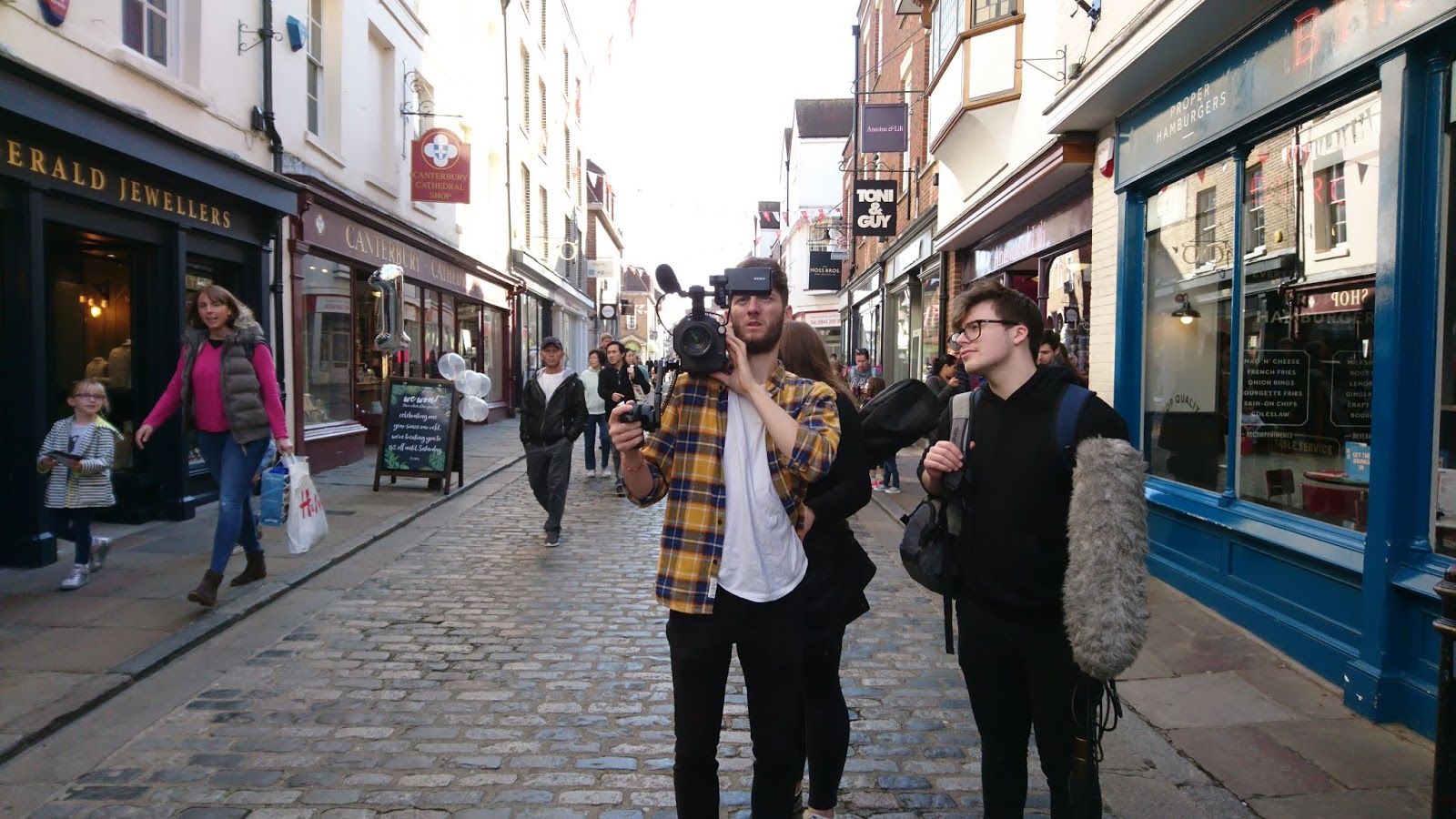
Once the actors had been fully prepared, I had another group of people to meet. Thanks to the brilliant people in the Media Arts department at Royal Holloway, I managed to enlist the services of a small student film crew to capture footage of the event (at very short notice!), as well as interview me about the process of making The Timekeeper’s Return and the story behind its inception.

After making sure that all the actors and businesses were fully set for the event’s start at 10 am, the film crew and I went to Antoine et Lili, where we had been given space to shoot the interview. Having set up the camera equipment, they hooked me up with a microphone and asked me questions such as “how did the event come about?” and “why Canterbury?” to prompt the monologues that would provide narration for the film.

Knowing how difficult it is to edit films filled with broken speech and hesitations, I did my best to make sure that my responses flowed clearly and steadily. Thankfully, we therefore didn’t have to do too many takes.

After the interview, we also decided to record a segment of me talking about digital storytelling while walking through part of the Cathedral Quarter. This proved much more difficult than we imagined, however, as Burgate was so busy with people (and occasional cars!) that it was impossible to get a clear run. In the end we moved to the slightly quieter Butchery Lane, but it still look us four or five attempts to get passable footage. The cobbles were also a unique hindrance because of how difficult it is to walk steadily on them while carrying a camera.

The film crew on Burgate

After the filming with me was complete, the crew went off to capture the game in action and to get some B-roll footage of the Cathedral Quarter.

Meanwhile, I set about checking in on all the actors and participating businesses, to make sure that everything was working without a hitch. I also visited all of the QR code locations, to ensure that all the stickers were still in place and intact.

Most of my time during the hours of the event was spent like this – running around like a headless chicken in my directorial role, to make sure that everything was running as smoothly as possible.

The wonderful cake made by the staff at Lakeland for The Timekeeper's Return, complete with the astrolabe logo

Participants read one of the story passages after scanning a QR code 

I did find some time to pursue other opportunities that came up during the day, and give myself some much-needed breaks.

At one point I met with another local artist, who I had connected with online as a result of advertising The Timekeeper’s Return on a mailing list. Then, later in the afternoon, I shared lunch and caught up with friends who had purposely travelled to Canterbury – some travelling quite significant distances – to try out the game I’d created and to support me.

It was very touching, and part of what made the day such a special one for me when I look back. It helped me to recognise how I wasn’t just a designer or director who had been brought in to run an event, but a valued part of these wider communities of artists, friends and local businesspeople.

A participant put a sticker with the event's astrolabe logo on her smartphone!

A gathering of participants

Though I was rushing around a lot on the day, on the whole it was apparent that everything was going remarkably well. Every time I entered one of the participating businesses, they remarked at how busy they’d been with people taking part in The Timekeeper’s Return, and how Burgate was buzzing with activity. I could see that myself just by stepping outside onto the street.

But as with all ‘live’ events, particularly those in public spaces, there are always unexpected occurrences that need to be negotiated. When the event is six hours long on a busy Saturday, as The Timekeeper’s Return was, the chances of unforeseen incidents only increase.

Of the few issues that did occur, nearly all of them were fairly mundane and easy to resolve quickly. At one point, I was informed that one of the QR code stickers became impossible to scan. Luckily, the people who first detected the problem were still at the site when I arrived, so I was able to replace it there and then for them with a sticker which worked properly.

I had also been made aware at one stage that a couple of groups of participants had struggled to spot one QR code in particular, and actually managed to skip it and move directly to one of the later QR codes in the story.

My solution simply involved talking to the businesspeople who were responsible for directing the participants at this stage of the treasure hunt, asking them to give a slightly clearer indication of the area where the next QR code could be found.

Perhaps the most concerning incident of the day came about an hour or two before the event finished.

I walked around to where the final actor was positioned at the end of the treasure hunt, only to find that I couldn’t see her anywhere.

The bag in which she kept all the rewards and sheets with contact details was still propped up against the wall where she had been positioned, but the actor herself was nowhere to be seen. Meanwhile, a group of street drinkers were playing music loudly from a nearby bench, to the bemusement of people passing by.

At first, I assumed that she might have just gone for a toilet break, and in the intervening time I filled in by taking on the persona of another one of Mia Augustina’s research assistants. For the couple of groups of participants I encountered, I congratulated them for finding all of the QR codes, explaining that Mia had already left to continue her research, but had left me with some gifts for those who had helped her return home.
          
However, after a little while someone from one of the nearby participating businesses found me to explain what had actually happened.

About ten minutes earlier, the street drinkers on the nearby bench had been swearing very loudly in front of the young children who were taking part. When my actor approached them and asked if they could tone down their language, they reacted very aggressively, threatening her and shouting directly in her face.
                   
When I spoke to her she was understandably quite shaken up, so I explained to her that I’d be happy to take over her role for the remainder of the event. In the end, though, she decided that she wanted to continue, and just needed a bit of time to regain her composure.
                                
Fortunately, when she returned to her role, the group of street drinkers had since moved on, and everything returned to normal.

Better than normal, in fact, as the numbers of players appearing before us only continued to rise. At one point, there must have been about 25 participants all gathered in the same place, having managed to reach that point of the treasure hunt at the same time.

A large group of participants gathers in the Cathedral Quarter

As the event drew towards a close, I saw a young girl walking the route of the treasure hunt with her dad. They still had a few more locations to visit before reaching the end, but the dad suggested to that they should leave early, as girl’s mum would be finishing work soon.

Clearly, this wasn’t what she wanted, and when the decision was finally made, she got upset and started crying.

Obviously I felt very sorry for her, though I couldn’t help but feel a flash of pride that the event and story I had designed had prompted that kind of emotional response. I had pitched the event as being accessible for all ages, but it’s always difficult to tell exactly how it will be received by different audiences. So it was especially rewarding to see younger participants getting so involved.

In the end, I approached them as they were leaving, and gave the daughter the rewards for finishing the treasure hunt anyway.

Once we were convinced that there were no more stragglers, the actors were free to leave, and I spent some time chatting with a couple of Cathedral Quarter businesspeople.

The overwhelming consensus was that the event had been a huge success, with over 200 people taking part and making the most of what the Cathedral Quarter’s built environment and independent businesses had to offer.

Beforehand, we were saying that we would be happy with half that number.

As the crowds dispersed, I said my goodbyes to those I knew who were visiting Canterbury for the event, and made my way around the Cathedral Quarter to remove the QR code stickers from their positions.

I then shared a celebratory drink with some of my local friends, and returned home completely worn out, but still glowing with an enormous swell of pride at what we’d achieved.

I think what strikes me most, looking back on the day of the event, are the very physical actions and materials that were necessary in order to make sure this ‘digital’ storytelling experience took place and ultimately was successful. From the posters and flyers that were printed in their hundreds, placed by hard-working volunteers on noticeboards, windows and other public displays across the Canterbury area, to the QR code stickers themselves and the surfaces to which they were stuck, the positioning and behaviour of the actors and participating businesspeople, and the smartphones through which the gameplay was largely mediated.

Furthermore, despite some unforeseen challenges on the day, overall we had some very good fortune. The weather remained stunning for the whole duration of the event; the technology stood up to the task (undoubtedly helped by the free WiFi offered by many of the Cathedral Quarter businesses); and the event was able to piggyback on the crowds drawn into the city centre for the opening day of the Canterbury Festival.

While we can certainly acknowledge these turns of fate, one factor that definitely cannot be overlooked is the commitment and hard work of those who offered their help to make The Timekeeper’s Return what we hoped it could be – the actors, businesspeople, testers, web and graphic designers, film crew, and everyone else involved in its production.

The Timekeeper’s Return aimed to foster a sense of community and shared heritage in the Cathedral Quarter, and it's lovely to be able to say that it is this combined effort of Canterbury people that comes to mind when I think back to this big, marvellous day.


The next and final post in the Making The Timekeeper’s Return series considers the feedback the event received, and its legacy.