Wednesday, 22 April 2020

Introducing Canterbury in 3 Words


For the past seven months or so, I’ve been developing a location-based game as part of my PhD research. Building on early experimentation in the first year of my PhD, as well as The Timekeeper’s Return, the mixed-reality game I created for Canterbury’s Cathedral Quarter in 2018, Canterbury in 3 Words is a digital treasure hunt that challenges you to discover and share stories unique to the city using the What3Words app.

The rule that defines the game is that each story must contain all three words in the What3Words address of the location it’s written about. Other players can then read stories shared on the game’s Facebook group and decipher the locations they describe using their knowledge of Canterbury and the What3Words app, aiming to find as many locations as possible and rise up the leaderboard.

In this post, I’m going to talk about the development of the game thus far: how I arrived at this concept for a location-based game, some of the gameplay features that players can expect, and what all this means for my PhD research.

______________________


To put it concisely, my PhD research looks at the potential of location-based games as platforms for eliciting and telling the stories that make places meaningful.

This research project is practice-based, meaning that I’m employing creative practice – in this case, designing and developing location-based games – as a method through which I get ‘data’ I can use to answer my research questions.

Alongside more conventional research methods such as ethnographic observation and interviews, this allows me to gain insight into the processes of idea generation, initial design, testing, iteration and production that shape location-based gameplay, as well as how players negotiate the architecture of game rules and platforms.

In geography and more broadly across the (digital) humanities, researchers looking at games have been reluctant to engage in game development practices themselves, even though their highly iterative processes have a hugely significant bearing on what kinds of player experiences eventually unfold from games.

While there are many valid reasons for this, it can consequently become difficult for researchers to detect the tacit (yet often highly influential) knowledges that shape how creative works such as games are produced. These can include ideas that were tried but abandoned, gameplay elements that changed over the course of the development, practical constraints that needed to be overcome, and unexpected occurrences or considerations that had to be managed.

Many of these more tacit elements of the design process were encountered on the winding path that led to the current version of Canterbury in 3 Words itself, which was born out of an amalgam of earlier creative experiments. These ranged from very basic game concepts that were never developed any further, to a full prototype that was tested in person by my PhD supervisors.

The useful thing about making games from an academic perspective is that, unlike in a commercial game development environment where there is much more pressure to make something workable sooner, even ideas that end up needing significant refinement or fail to work as intended can provide useful findings for the research.

In fact, it wasn’t until late summer/early autumn last year when the idea of using What3Words addresses to tell stories about places first came to mind.

I already knew a little bit about What3Words and how it works – mostly through news stories about how it had helped the emergency services get to incidents in remote locations. What3Words claim that their service is built to ‘make everyone everything and everywhere easy to find’; the idea being that telling three words to someone is a much more efficient way of communicating location than the strings of digits we use to define GPS coordinates.

But I wanted to find out what critical geographers and cartographers had to say about the implications of this new method of identifying points on the earth’s surface.

As expected, many of the usual caveats of locative technologies had been discussed, such as how the geodetic movement of the earth can affect the accuracy of locative addressing systems over time. Many commentators also raise concern about the implications of an addressing system that is directly tied to corporate interests, when addresses in general are so important to everyday life globally.

From a cultural geography perspective, I’m most interested in the repercussions that associating certain words with certain places might have for how locations are imagined, represented and performed.

We can already see evidence of these kinds of impacts in the ‘gimmicky’ quality of the What3Words addresses. For example, we might chuckle at an opportune placement of words (such as ///best.home.ever, which is apparently a tree in Framingham, Massachusetts), and there are whole forum topics devoted to finding these kinds of addresses on the internet.

You can imagine how the addresses could become problematic, though, when their words become attached to politically or culturally sensitive sites. Yet What3Words continually distance themselves from the notion that the words used in their addresses could possibly ‘mean’ anything other than being signifiers of location.

It occurred to me that using the words from What3Words addresses as tools for storytelling, while adopting the format of a treasure hunt to play with the goal of making things ‘easy to find’, was a neat way to problematise such top-down, instrumental applications of locative technology while providing a fun yet challenging framework for people to tell their own stories of place.

In the way that the addresses themselves would provide the prompts for people to recount their tales, the gameplay demonstrates how the signifiers we attach to locations – and the cultural associations we make with them – are a crucial part of how they become meaningful to us as places.

Once I had settled on how the game was going to work, the next phase of the development was testing it.

Drawing on a wide range of local contacts, I managed to recruit 15 local people to play the game over a period of three weeks in November and December 2019. As well as recording my observations from activity on the game’s Facebook group using a research diary and screenshots, I then interviewed the testers who were actively involved in the game activity.

After transcribing all these interviews, I was left with a lot of text and images from the Facebook group posts, screenshots, research diary entries and interview transcripts to analyse.

Not only did I need to think about the relevance of what I had found from a geographical point of view (in response to my research questions) but I needed to think about how these findings would shape the design of the game going forward.

This segues nicely into talking about the gameplay features, where I can explain some of my design ideas in more detail, my decision-making regarding things that have changed or stayed the same since the test, and the implications for how players engage with places in Canterbury and their stories.

The first thing to note about Canterbury in 3 Words is the area in which the game is played: within the city walls.

As I’ve written on the game’s FAQs:

“The game area needs to be quite clearly defined so that people know which areas ‘count’ when hunting for story locations. Canterbury as a city covers a large area, particularly if you include suburbs, the University of Kent and other outlying areas, and it can become difficult to identify where the city begins and ends, let alone identifying one particular location within it. The city walls are a historic boundary line encircling an area of the city centre that contains a large number of unique and interesting sites, while being fairly easy to navigate. It will typically be the part of Canterbury that people are most familiar with.”

Interestingly, the original decision to set the game within this boundary was a fairly arbitrary one. As the game was only being played by 15 people, it seemed inappropriate and potentially unsatisfying to ask people to search for story locations across the whole administrative area of Canterbury.

Yet it was only when interviewing the game’s testers that I realised just how important this boundedness was for people’s experiences of the game. It prevented them from ever becoming too overwhelmed with possible locations for stories, and meant that they had a clearly defined area they could explore to search for story locations they didn’t immediately recognise.

Of course, once players know to stick within this bounded area of the city, the key activity that defines the gameplay of Canterbury in 3 Words is the sharing and finding of stories about places.

While this task might seem fairly self-explanatory on the surface, the requirement for the stories to include all three words from their locations’ What3Words addresses, and to have a photograph attached to the text, creates some interesting opportunities for creativity and strategy.
                            
If the place in question is covered by multiple What3Words squares, for example, a story author can choose a square with words that are easier, more appropriate or more interesting to fit into their story.

The writer can also be tactical about how they present information in their story text and image. Framing the image of the location in a certain way can make its context more difficult to identify, or ensure that only those with specific knowledge will be able to recognise it. Similarly, the style in which a story is written can make words that might otherwise seem out of place sound natural.

Click to enlarge

There are tactics that people searching for the story locations can use too.

When scanning the story text, sometimes a word might strike the reader as being unusual to use in a particular context; as if it has been shoehorned into the story. This might suggest that the word is one of the three from the location’s What3Words address – information that can be particularly useful if you have a rough idea where the location might be. This can make identifying the precise square on What3Words much quicker.

Click to enlarge

Information can also be gleaned from the framing of the story image (you could think about: where is the feature positioned? What kind of material is it made out of? What else is around it?) or the content of the story itself, which might suggest the kinds of activity you could expect in this location.

Once a person has found a story location, they should comment on the original post on the Facebook group to mark their find and share their experiences of finding it. But one question that might come to mind when someone comments on a story: how do you know if that person has actually found the story, or if they are just saying they have?

Well, in the test, the system operated so that once a story location had been found, the finder had to message the story author on Facebook with the appropriate 3-word address to confirm their solution as correct. Once they had received confirmation from the author, they could comment on the post on the Facebook page.

However, the test revealed that there were occasional issues with some participants not responding very quickly, or at all, to participants messaging them with solutions. This was sometimes because the author missed the message (e.g. if it appeared in their ‘Message Requests’ on Facebook, or was buried by other messages); sometimes people’s other commitments were a factor.
     
To minimise the frustration that this kind of delay could cause, I’ve changed the system so that a player can comment on a post as soon as they have worked out the story location.

Given that each story has to include all three words of the location’s What3Words address, it’s very unlikely that a player’s solution would be wrong if they have managed to find three words in a story that match a What3Words address in Canterbury (and if the location makes sense when looking on satellite view/Streetview). So it made sense to give finders the satisfaction of commenting on the post as soon as the solution is identified, and earning their point for the game’s leaderboard.

Now, the responsibility to check a solution is the story author’s. By monitoring activity on their story posts and messaging people who discover the story locations, the gameplay encourages them to take ownership of their stories and take interest in how people respond to them.

This is very similar to Geocaching, where anyone can log a geocache as ‘found’, but the geocache owner will eventually discover from checking the physical logbook in the cache container whether somebody has lied about finding it. It is also the cache owner’s responsibility to maintain their cache.

The evidence from Geocaching suggests that giving players greater responsibility in the running of the game in this way can not only help to organically maintain a high standard of gameplay, but also to create a benevolent community with the shared aim of creating positive experiences for other players.

Speaking of the sociality and community that can develop around location-based games, there is one major change I’ve made to Canterbury in 3 Words since the test: the incorporation of regular community events as part of the gameplay.

The decision to organise community events for the game was partly made after talking to some testers, who despite enjoying the game found that the experience of writing about and searching for story locations could be quite solitary. As the game can be played at any time, there is only a small chance that players would ever encounter each other while taking part, making it difficult to foster any sense of community among participants.

I also was keen for the game to speak more to the ‘live-ness’ of the city – the mobile, fleeting and partial ways in which we encounter different places in Canterbury during our daily lives – rather than players only feeling as if they were interacting with the urban fabric as a series of static locations to find or write about.

As well as being a platform for existing stories, I wanted new stories to emerge as a result of the gameplay; meaningful experiences that players can have as a result of actively taking part.
      
Looking at other location-based games such as Pokémon Go and Ingress, community events have been a successful way of bringing together individual players – many who might have limited time to play during the working week, or who otherwise struggle to meet and play with others – within particular areas to share collective experiences organised around the gameplay.

For the community events in Canterbury in 3 Words, stories will be commissioned around particular themes when the event announcement is made. These stories will then be arranged in a form of treasure trail, for which players will have to work together to find all of the locations. Importantly, story locations for these events will not necessarily be restricted to within the city walls. Rather, the sites will largely depend on what theme is chosen for the event.

Clearly, given the current pandemic situation, these events cannot take place physically at this moment in time. I’m still developing my ideas about exactly how they will work virtually, but I’m currently taking inspiration from Alternate Reality Games and other large-scale, internet-based, collective activities. To some degree, what I eventually end up with will also depend on the content of the commissioned stories themselves.

Regardless of what format they take, I’m hoping that the events will be able to bring to life some of the lesser-known stories that populate the city in a memorable way, encouraging conversation and sociality between players.

______________________

So all that’s really left to announce is the date that people will be able to try the game for themselves.

The public version of Canterbury in 3 Words will be launching on Friday 24th April. Bookmark the links below if you're reading this before then; otherwise follow the links now to join in the fun!

Obviously, spending so much time indoors isn’t exactly how I expected this stage of my PhD fieldwork would go, for both me and those who play the game.

But I’m fortunate that Canterbury in 3 Words lends itself quite well to being played purely on the internet, given the range of online tools players can use to engage with the cityscape remotely such as Google Streetview, satellite view on What3Words/Google Maps, and search engines/image databases. Indeed, these services were used regularly by the game’s testers to play remotely during the cold and wet winter months.

I’m hopeful that those who are familiar with Canterbury will be able to use the game as an opportunity to reconnect with the city at a time when possibilities of travelling to and through it in person are restricted.

If you would like to play the game yourself, or want to share it with someone else, you would be more than welcome. Join the Facebook group here and check out the information website for the game here.


Thursday, 26 March 2020

Niantic Wayfarer and Pokémon Go: Cultural Geographies of Wayspot Reviewing


During November last year, a significant new feature became available for players of Pokémon Go who had reached level 40, the maximum possible level in the game: the ability to submit nominations for new Pokéstop locations. Pokéstops are the in-game modules located at points of interest, which can be spun to receive items, quests and gifts to send to friends.
                    
Alongside this new capability, this same group of level-40 players has also been able to participate in the review system for these ‘wayspots’, called Niantic Wayfarer.

Here, submissions from other players are assessed according to a set of criteria outlined by Niantic, which new reviewers are tested on when they sign up. These criteria determine whether a location becomes a new wayspot, or is rejected. If approved, the wayspot will usually appear in all of Niantic’s games: Pokémon Go, Ingress and Harry Potter: Wizards Unite.

Over the past three months, I’ve been getting to grips with the process of submitting Pokéstop nominations and reviewing them using Niantic Wayfarer. In this post, I’m going to discuss the guidance given to reviewers of wayspot submissions, and the implications that these criteria have for how Pokémon Go players engage with the places they play in.


What makes a good wayspot?

On Wayfarer, Niantic give the following guidance to reviewers for identifying good wayspot nominations.


One immediate observation to note from these criteria is the focus on discovery.

Niantic want wayspots that draw attention to locational features that players might otherwise be unaware of, particularly from the perspective of visitors to an area. They’re asking locals to draw on their fine-grained knowledge of place to add content to their games – and particularly content that will enhance the experience of discovery and novelty among their mobile player base.

By aiming for these types of niche locational features, Niantic are potentially tapping into a broader trend of ‘offbeat’ tourism. Facilitated by Instagram, travel blogging/vlogging, websites and guides like Atlas Obscura, as well as locative media that make finding these sites easier, this slice of the travel and tourism sector has become remarkably lucrative with the growth of the so-called ‘experience economy’.

Indeed, it’s worth highlighting how Niantic as a company have been developing increasingly close links with the tourism industry and cultural sectors across the globe. For a while now, we have seen in-game events to mark World Tourism Day on Pokémon Go, as well as regional Pokémon that (in theory, at least) can only be obtained by travelling to another part of the world or trading with someone else who has.

They are even working with cultural departments in municipal authorities across the world to host events for players of Niantic games. For example, the locations of this year’s Pokémon Go Safari Zone events in Taiwan, St. Louis, Liverpool and Philadelphia (the last three now postponed) were decided following a bidding process by the cities involved. The competition was seemingly justified by figures reflecting the impact of previous Niantic events for the local economies of previous host cities.

But what do these trends mean for how players of Pokémon Go encounter and make sense of their surroundings?

Alongside these guidelines for making ‘good’ wayspots, Niantic have also included a list of specific kinds of nominations that they value highly.


Here, we see more explicit recognition of education and discovery being ‘cornerstones’ of Niantic as a corporation.

But what is most notable about this segment of the guidance is how Niantic are actively aiming to produce landscapes of play in their own image – to shape player engagement with places in ways that accord with their company values. These include transport hubs like train and bus stations that ‘connect and unite people around the world’, public parks that encourage ‘walking, exercising and enjoying public spaces’, and libraries for their core values of education and discovery.

Of course, thinking critically, we should be asking what aspects of place are left out of the imaginaries that Niantic are curating through Wayfarer. This is where their criteria for ‘low-quality nominations’ become significant.


‘Low quality’ nominations


In this section of the guidance, Niantic is clearly setting out exactly what kinds of places should not be interacted with by players of their games. From a practical standpoint, these would appear to be for reasons of safety (both of players and non-players), accessibility and potential legal ramifications for the company.

Clearly, as a large games company with a vast player base, and one very much in the public eye, there is little scope in Wayfarer for anything transgressive when it comes to the usual caveats of location-based gaming: private property laws, emergency service operations, key infrastructure and restricted sites (though examples abound of people playing Pokémon Go itself in transgressive ways).

But what I have found particularly fascinating about these guidelines for ‘low quality’ nominations is the ineligibility of those that are ‘natural features’.

Aside from the contention surrounding the word ‘natural’, which could be debated endlessly (e.g. how the concept of ‘nature’ itself is produced by humans; the social, cultural and/or political implications of designating certain entities as ‘natural’ and others not; how humans and our constructions are themselves part of nature, etc.) there are quite a few conceivable cases where the logic behind distinction can become problematic.

Following Niantic’s criteria, a geological feature that has been present for tens of thousands of years would be rejected as a Wayfarer nomination. Yet a sign for the same feature that probably wouldn’t last 20 years without repair or replacement would be eligible.

This is despite advising reviewers to reject nominations that ‘do not appear to be permanent’ in the same section of the guidance.

Here, longevity as a factor for eligibility is seemingly trumped simply by the presence of man-made objects.

Furthermore, there are cases where, even going by conventional social and cultural norms, the boundaries between a man-made and natural feature can be hard to distinguish. These include sites like ruins, where plants will invade and grow without careful maintenance. How overgrown does a man-made object need to become before it is no longer seen as ‘man-made’? And how feasible is it for a reviewer to make this distinction from the photograph included in the submission?

One important geographical observation is that the impact of these criteria will be felt differently depending on the types of places where people play.

The difficulties faced by rural Pokémon Go players are already well-established, with fewer spawns (sites where Pokémon can appear), Pokéstops and Gyms than their urban counterparts, all of which are crucial for in-game events and general gameplay.

However, it is also in rural areas where these ‘natural features’ are more likely to be the culturally important sites that players will want to showcase by turning them into Pokéstops. Even where there are relevant man-made objects to nominate in rural areas, these are generally less likely to have signs and other associated ‘man-made points of interest’ when compared to similar sites in urban areas.

So while Wayfarer might appear to democratise the process of getting new Pokéstops and Gyms wherever you live, the criteria for assessing nominations still work in favour of player communities in more populated, built-up, well-signposted locations.


Grey areas and community standards

As we’ve already seen, the guidance given to Wayfarer users may not always be easy to apply in practice. Niantic itself recognises that its criteria could provoke differences in interpretation, and have created a page on ‘potentially confusing nominations’ in the Support section of Wayfarer.

This additional advice covers a number of cases that might be interpreted differently depending on which aspects of the guidelines reviewers prioritise, including graffiti/street art, cemeteries and memorials, playgrounds, post offices and trail markers. It also gives specific advice regarding the images used in nominations (they should be good quality, and shouldn’t include people).
  
When it comes to approving or rejecting these ambiguous submissions, the deciding factors seem to mirror many of the key considerations already noted: levels of public and pedestrian access, permanence, personal privacy, distinct cultural value and accordance with Niantic’s ‘cornerstones’ of discovery and education.

An example of one of the 'potentially confusing' nominations Niantic discusses on their support pages for Wayfarer

Yet in recent months Niantic have added two further clarification pages to the ‘Wayspot Acceptance Criteria’ Support page, one in October 2019 and one in January 2020. These seek to clarify even more ambiguous cases that Wayfarer reviewers have raised; the latter reacting particularly to the massive influx in new reviewers since the function was opened to Pokémon Go players in November.

As the number and range of submissions has increased, it has become clearer that many landmarks on the ground are still not easily categorised by Niantic’s criteria. As such, the responsibility for distinguishing between worthy and unworthy wayspots is increasingly passed onto the Wayfarer community.

This power is not insignificant. If reviewers unanimously decided to accept a nomination that would be deemed ineligible according to Niantic’s criteria, the only way the wayspot would be removed from their games is if somebody reported it to the company. Because players of Niantic games benefit from these wayspots, it is unlikely that they will report it themselves (unless they are particularly community-minded). So it may not be removed until the wayspot has caused such a level of disruption that non-players become aware of it.

In practice, it would be difficult to coordinate such a unified response, as reviewers have hardly any control over how wayspot submissions are allocated. But all it takes is for a few reviewers to make the same decision, and an otherwise ‘inappropriate’ submission can slip through the net.

Notorious examples include strip clubs being accepted as ‘unique local businesses’, while more worthy sites such as Michelin-star restaurants or local charitable organisations are rejected as being too ‘generic’.

While these are worst-case scenarios,  the more significant observation to make is that the looseness of Wayfarer’s reviewer guidelines has created space for community standards to develop. This is particularly impactful when it comes to landmarks that are culturally specific, which may not be adequately accounted for in Niantic’s criteria.

In the UK, this has happened with postboxes. There is now a de facto rule amongst Wayfarer reviewers that only postboxes bearing the Royal Cipher of King George VI or earlier will be accepted as wayspots, due to their historic value. Meanwhile, the vast majority of postboxes that bear the Queen Elizabeth II cipher are ineligible.

Adjacent postboxes bearing the Elizabeth II cipher (left) and George VI cipher (right)

In establishing these standards, Wayfarer communities are able to assert a degree of agency in determining sites that are culturally valuable and therefore worthy of inclusion in Niantic’s games.

Before we praise this as an exemplar of successful community cohesion in Niantic’s games, it’s worth pointing out the process through which Wayfarer reviewers are allocated submissions for new wayspots.

The submissions that reviewers receive can derive from any of the following categories: sites within a 150-mile radius of a reviewer’s last play location; from anywhere across their home country; from any of their home country’s territories; from bordering countries; or from the ‘home’ and ‘bonus’ locations that reviewers can set in their Wayfarer settings.

Due to the wide distribution of reviewers assessing any given submission, there are likely to be differences in the value judgements these reviewers make of sites that are submitted, particularly if the value of a given landmark is only likely to be recognised at a very local scale.

An example from my local Wayfarer community is the lampposts supplied to the city of Canterbury by the Biggleston company until 1963, which have very distinct features. Though the Biggleston lampposts that remain arguably have significant cultural value to citizens of Canterbury, to many reviewers from outside the city these lampposts will seem too generic to accept as points of interest.

So while there is scope in Wayfarer’s model for community standards of cultural value to develop – promoting discovery and learning about places that players of Niantic games visit – there will always be inconsistency in how both these and Niantic’s own criteria are applied to any individual submission.


Degrees of agency

Though Wayfarer is evidently not an uncomplicated system, it does serve some very clear purposes for Niantic.

As you would expect from a company whose profit is directly tied to user engagement, Niantic want to increase engagement with their games. One effective way of accomplishing this is to increase game content at a local level. Because Pokéstops and Gyms in Pokémon Go are so essential to the enjoyment of the game – giving you items that allow you to catch and heal your Pokémon, eggs you can hatch to get more Pokémon, and being the primary conduits for in-game events – the more that appear in a given area, the greater the ability of players to enjoy the game and play it as Niantic intends.

If Niantic were to evaluate all of the suggested wayspot locations themselves, there is simply no way they could cope without hiring a large and expensive workforce. By offloading this labour to a more-than-willing workforce – committed players who have already spent countless hours (and money) on Niantic games – not only do they avoid these significant costs, but they actively deepen the investment of players in Niantic’s values, objectives and the wellbeing of their games.

For these reasons, it is easy to see why Wayfarer exists and has made a notable impact on Niantic’s player communities.

Yet, like any form of distributed authority, its application is largely dependent on the individual people and communities of practice making the decisions, as well as the particular cases they deal with.

Niantic’s guidance for Wayfarer reviewers at once articulates a quite distinct set of values and responsibilities, yet leaves ample room for ambiguity and interpretation when dealing with the specificities of real-life submissions. This system can potentially account for local cultures and community values better than a single centralised reviewing operation run by Niantic Headquarters.

However, the process of allocating nominations, whereby reviewers can receive submissions from places and cultures with which they have very little familiarity, also works to hinder the development of coherent community standards.

This situation isn’t helped by the current lack of incentives for players of Niantic games to actually review Wayfarer submissions. As it stands, there are no in-game rewards for doing what is basically user-friendly admin, meaning that the only players helping to shift the backlog of wayspot submissions derive from the most commited segment of this already highly-committed group. Because the number of committed reviewers is low, the geographical range of submissions they receive is extensive. The potential for inconsistency in how these nominations are valued grows.

What the development of Wayfarer certainly has done is illuminate some of the geographical implications of Niantic’s particular brand of location-based gameplay. By revealing the underlying architecture of values, standards and systems that guide how content is added to their games, we can critically examine how the company is seeking to shape how we interact with our environments, and how this architecture is negotiated in practice by communities of players.


Tuesday, 31 December 2019

Making The Timekeeper's Return: Legacy


After the big day, I was invited to run one more meeting with the Cathedral Quarter team – to talk about how The Timekeeper’s Return went, and to celebrate the efforts of everyone involved in making the event a success.

When planning my presentation for this meeting, I decided to gather all the information I could find that would gauge how much work went into the event’s development, and the impact we made on both participants and the wider public. 
    
I worked out that I’d spent about 800 hours of my time on the project in total (the equivalent of 33.3 whole days!), while voluntary work from other individuals included 24 hours of graphic design work, 22 hours of acting and recruitment, and 6 hours of continuous work from the film crew who helped us capture the day (and many hours on top of this to edit the footage).

I had no way of measuring the substantial workloads taken on by individuals in the Cathedral Quarter team, which included help with the initial concept and ideas, marketing, admin, logistics, printing and organising meetings. But judging from the many hundreds of emails that passed between us all, I know it must have been significant – certainly when you’re running a business at the same time.

I also spent some time looking at the impact we made on social media.

In total, the main event page on Facebook reached 17,300 people with nearly 1,000 total views; while posts from the Cathedral Quarter Canterbury page on Facebook were received by 6,100 people (up 1000% from before the event), with 1,700 of these users engaging with the posted material (up 1800%). This led to an additional 40 people ‘liking’ the Cathedral Quarter Canterbury page, an increase of 900%.

On Twitter, the Cathedral Quarter account made 10,600 impressions since the event’s online launch, with 38 link clicks, 36 retweets and 66 likes in total.


Feedback

Let’s now have a look at some of the feedback from participants on the day.


Edd Withers, local entrepreneur and founder of Canterbury Residents Group:

The Timekeeper's Return was enlightening, exciting and intriguing. The storyline delivered a fascinating experience, and the people we met along the way enchanted with clues and messages from the story. The method of using hidden QR codes to keep us on the hunt to continue the game was easy to use and a great use of the technology we all have in our pocket, and the simplicity of the process was welcome. When we arrived to start the game, we were given clear instructions but still felt like we were starting on a mysterious journey. A wonderful way to spend an afternoon, exploring and learning - we felt like children again with a sense of wonder!


Lisa Carlson, CEO of Canterbury Connected Business Improvement District:

The Timekeeper’s Return was a magical and remarkably successful event, with more than 200 people of all ages enjoying following Mia Augustina’s adventures through time and space. Burgate was buzzing on the day, with locals walking alongside visitors from other parts of Kent (and even other counties) to discover what the Cathedral Quarter has to offer. What struck me most as I completed the treasure hunt was how Jack Lowe’s enthralling story weaved past and present together so expertly. Blending local history with real-life connection to businesses in the Cathedral Quarter today, participants had the opportunity not only to learn about the often-overlooked stories and landmarks that make this historic quarter so unique, but also to visit a diverse range of shops and eateries, engaging with people there who are passionate about what they do. It was heartening to see how much shopkeepers really seemed to enjoy the experience, playing their roles enthusiastically and doing their utmost to accommodate participants, even when they were busy. This is also a testament to the depth of planning that must have taken place to ensure all the different components of the event ran smoothly. Altogether, The Timekeeper’s Return will live long in the memory for the way it has helped to develop and promote a coherent, exciting Cathedral Quarter community. It’s a wonderful example of what can be achieved when the enthusiasm, work ethic and creativity of local artists and businesspeople come together. I can’t wait to see what Jack Lowe and the Cathedral Quarter do next.


Comments from feedback sheets and The Timekeeper’s Return event page:

I thoroughly enjoyed The Timekeeper's Return. Not only was it fun to spend the afternoon doing something different, but it also gave us an opportunity to get to know the history of Canterbury better, thanks to the vivid storyline. We also spoke to people we never would have had conversations with otherwise, like the shop assistants and other people who were doing the treasure hunt. Really impressed and I hope there'll be another treasure hunt soon!


Firstly, congratulations on creating such a fun treasure hunt! We spotted it advertised on Facebook and it looked great, so we thought we'd join in and do some exploring! Loved the simplicity of interacting with the QR codes, which are a good size to hunt for – learned a little about the area and Bell Harry Tower which we didn't know either! Impressed with how all the shop staff were keen to join in and make the event entertaining too!


Thank you so much for a great afternoon! We all had fun following the clues. The story was good and kept the kids interested. We went into a part of Canterbury we don’t normally venture to and enjoyed going in the shops we haven’t been in before.


That was so much fun! Learnt so much about the area and saw things I'd never noticed in the 30 years I've lived in Canterbury. Thanks so much for organising such a fantastic event!


And a big thank you to all the businesses that were involved for being so gracious with us treasure hunters even though they were so busy.


Very fun time, exploring and learning about the town. Loved the sense of discovery when you finally figured out a clue. Mia was the bomb – very immersive and convincing acting.


A well-researched, organised and interesting experience. A wonderful way to experience this part of Canterbury.


Brilliant event, well done to everyone involved. The organisers, the local businesses and the roaming helpers (who were very much needed!) This kind of event is what makes our local area great. Bravo.


Thank you for a lovely afternoon exploring shops and learning history from Canterbury that we had no idea about! It was so immersive and such a joy to take part in, from the hosts to the fantastic staff in the shops we visited we were thrilled!! Thank you again!


We had such a great time doing this!! Thank you so much for organising it. So many lovely shops we'd never been in before despite living in Canterbury. I'm planning a Christmas shopping day to revisit without the kids very soon!!


We had a great time following Mia's adventures and finding out more about Canterbury. Thanks for a great afternoon activity. Looking forward to another one?!


Absolutely brilliant idea. Our 3 year old loved it. Hope you do another next year :)


Thanks for creating this treasure hunt, it was great fun, and nice to see so many local businesses participating. Will the whole story be available anywhere to read through (when we're not excitedly rushing from clue to clue!)?


My partner and I thoroughly enjoyed the timekeepers return event. It was fun for all ages (we are both 21) to do and we learnt a lot more about the city we live in. I think more activities like this need to happen to encourage people to appreciate this city. Thank you!


Thank you. Had so much fun. Was reminded of history I learnt a long time ago, and learnt some new things too! Looking forward to the next trail.


Alongside this positive feedback, perhaps the most heartening interactions I’ve had since the event are with those asking me how I found sources for research into Canterbury’s history, how this fits into my own plans for the future, whether I’d be making other events or games of this type, and what it takes to make this kind of work.

On this last point, over the past year I have frequently given informal advice to individuals about the different possibilities of location-based and AR media for a wide range of projects. This has often revolved around particular apps and technologies that might be useful and the kinds of knowledge and/or skills typically required, as well as the possibilities and challenges for storytelling in these contexts.

Professionally, my experience of creating The Timekeeper’s Return has even led to consultancy work on location-based and narrative games.


Prize draw

As well as receiving rewards on the day, everybody who completed the treasure hunt was entered into a prize draw to win a bunch of excellent prizes donated by local organisations.

I had the pleasure of handing out the prizes to the happy winners in person two weeks after the event, at a small prize-giving held in the heart of the Cathedral Quarter.


We were especially delighted to see the winners of the grand prize – tickets for four people to attend the Christmas Pantomime at the Marlowe Theatre – enjoying their evening out.


The bigger picture

Since last autumn, Simon Yule from the Canterbury Cathedral Shop has written this short report of the event for the Cathedral Quarter website, and I gave a presentation that featured The Timekeeper’s Return at the Royal Geographical Society Postgraduate Forum Midterm Conference in April, which discussed the opportunities and challenges of making digital narrative works as a researcher.

Looking forward, many of you will be aware that this is just the start of my ambitions when it comes to designing location-based narrative games.

The research upon which my practice-based PhD is based involves creating, testing and producing more participatory media arts of this type, and I’ll be sharing further details about the work I’ve been doing for this project soon.

If you’re interested in getting involved in any upcoming game tests or public events I decide to run, stay tuned here and on my social media, or get in touch using the details on my About page.

As for the Cathedral Quarter, I’m pleased to say that the area is as welcoming and enchanting as ever, and the businesses have built on our previous success by hosting more well-received events.

Although small businesses are facing a very difficult economic climate across the country at the moment, particularly in retail, Canterbury has remained remarkably stable in comparison.

No doubt a big part of this relative success is down to the hard work and positivity of independent businesspeople like those in Cathedral Quarter, who make Canterbury city centre so unique.

I’d like to thank everyone at the Cathedral Quarter once again for commissioning me and for the continued faith they showed in me to deliver this project. I look forward to seeing you all and hopefully working with you once again in the future.
                                                                        

Credits

The Timekeeper’s Return
Designed, written and directed by Jack Lowe

Website design
AM Marketing

Graphic design
Sam Lowe

Recruitment
Canterbury Christchurch University Outreach

Testers
Oscar Dymond
Paul Dymond
Wendy Dymond
Tim Fairhall
Julian Steward

Marketing
Maria Cockburn
Jack Lowe

Printing
Canterbury City Council Print & Mail Centre
Omicron Reprographics

Participating businesses (in order of appearance)
Lakeland
Canterbury Cathedral Shop
Fitzgerald Jewellers
Canterbury Pottery
Canteen
Loake
Antoine et Lili
Biggs Opticians
Wrapped!
The Chinaman
Fired Earth
Chapter
Moat Tea Rooms
Veg Box Café
Stilwell Jewellers

Rewards kindly provided by
Canterbury Cathedral Shop

Prize draw prizes kindly provided by
The Marlowe Theatre
Chapter
Moat Tea Rooms
Canterbury Cathedral Shop
The Chinaman
Antoine et Lili
Canterbury Pottery

Special thanks
Maria Cockburn
Stefan Colley
Adam Ganz
Sandra Hadfield
Chris Needham
Mark Pegg


Acting


Dr. Mia Augustina
Oksana Savchenko

Rose
Rebecca Sampson

Max
Elizabeth Waterman-Scrase


Filming


Producer
Alex Preston

Camera operators
Zdravko Zhelev
Jules Davison

Sound
Laura Bailey

Assistant producer
Lexi Budd

Digital imaging technician
Morgan Davies


The Timekeeper’s Return was created by Jack Lowe on behalf of

Canterbury Cathedral Quarter

© 2018 Jack Lowe


Sunday, 22 December 2019

Making The Timekeeper's Return: The Big Day


Printing and cutting out QR code stickers in preparation for the event

I told myself that I’d get at least 7 hours of sleep before the big day, but who was I kidding?

Instead I spent several hours printing and cutting out about 10 sets of 18 QR code stickers (I needed spares), as well as over 200 stickers with the astrolabe design on, as rewards for those who completed the treasure hunt.

In the end I think I got between 3 and 4 hours of sleep. This obviously wasn’t ideal, but I knew adrenaline would carry me through the day.

On the morning of 20th October I got into town at 7.50am, and the first thing I did was walk around the Cathedral Quarter and stick up the QR code stickers while there were as few people around as possible.

It was a good job I printed spare stickers, as I managed to stick one up in the wrong location at one point! Thankfully I realised what I’d done straight away and was able to replace it with the correct sticker.

After these early morning exploits, I had a bit of time to get some breakfast at McDonald’s and take things easy before the real work began.

The first task was to meet and prepare the three paid actors who the Cathedral Quarter and I had employed for the day.

Arranged by a contact of ours in the Canterbury Christchurch University Outreach team, the actors were there to facilitate the running of the game and, like the participating businesses, help forge a link between the past and present Cathedral Quarter and reinforce the participants’ sense of immersion in the narrative. Dressed in plain clothes, yet acting the roles of characters in the story, they became part of the ‘secret society’ that players entered into as they explored this part of the city.

The actors were briefed by me in advance of the event, which gave them a back-story to their character, some suggested lines they could use in different circumstances (e.g. based on questions they were likely to be asked, or problems that could arise during the game), and some key adjectives to describe how they should portray themselves in front of the participants. Everything else was open to improvisation.

On the day, I gave them all a tour of the relevant parts of the Cathedral Quarter too, to make sure they were aware of where the key locations were, and what to expect in the different sites.

Our first actor played the character of Mia Augustina’s research assistant, Rose, who stood at the starting point for the treasure hunt at the compass in Longmarket Square. Her job was to introduce herself to those who had turned up to take part, present them with the opening QR code, and provide guidance on installing a QR code scanner, how to scan QR codes, how long the treasure hunt would roughly take to complete, and any other general information about the event.

Rose positioned at the compass in Longmarket Square, where the treasure hunt began

Then there was another assistant, Max, who was asked to float around Burgate and the Buttermarket where some of the early points of interest were. She was on hand to provide any guidance to participants who weren’t sure what they were supposed to be doing, were lost, or were having problems with mobile internet coverage.

Finally, there was Mia Augustina herself, who was positioned at the end point of the treasure hunt. As well as letting the participants know that they had finished, she was responsible for giving out the small rewards earned by each participant who completed the game, taking down contact information for those who wanted to enter the larger prize draw, and making a record of how many people finished the trail in total.

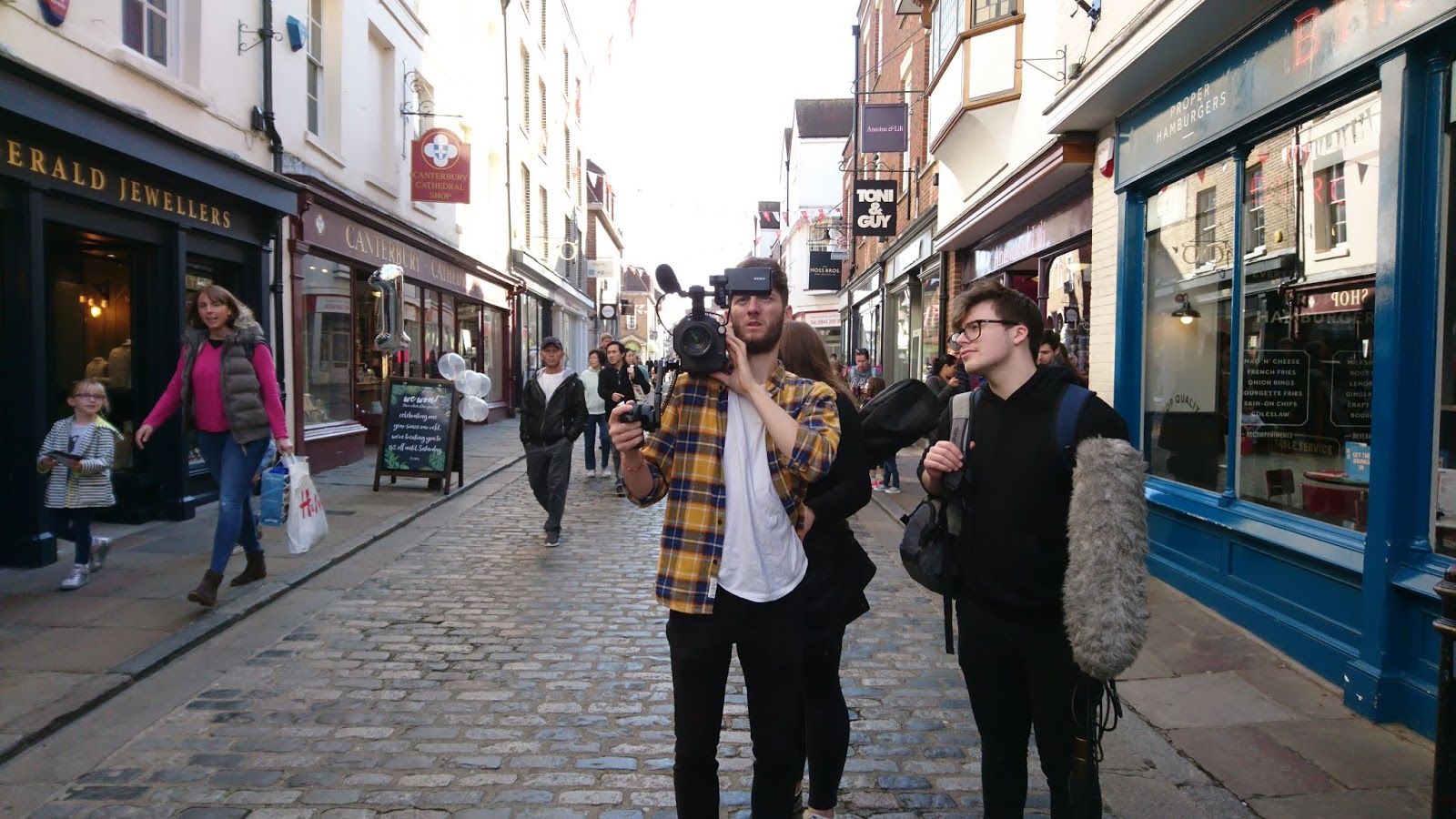
Once the actors had been fully prepared, I had another group of people to meet. Thanks to the brilliant people in the Media Arts department at Royal Holloway, I managed to enlist the services of a small student film crew to capture footage of the event (at very short notice!), as well as interview me about the process of making The Timekeeper’s Return and the story behind its inception.

After making sure that all the actors and businesses were fully set for the event’s start at 10 am, the film crew and I went to Antoine et Lili, where we had been given space to shoot the interview. Having set up the camera equipment, they hooked me up with a microphone and asked me questions such as “how did the event come about?” and “why Canterbury?” to prompt the monologues that would provide narration for the film.

Knowing how difficult it is to edit films filled with broken speech and hesitations, I did my best to make sure that my responses flowed clearly and steadily. Thankfully, we therefore didn’t have to do too many takes.

After the interview, we also decided to record a segment of me talking about digital storytelling while walking through part of the Cathedral Quarter. This proved much more difficult than we imagined, however, as Burgate was so busy with people (and occasional cars!) that it was impossible to get a clear run. In the end we moved to the slightly quieter Butchery Lane, but it still look us four or five attempts to get passable footage. The cobbles were also a unique hindrance because of how difficult it is to walk steadily on them while carrying a camera.

The film crew on Burgate

After the filming with me was complete, the crew went off to capture the game in action and to get some B-roll footage of the Cathedral Quarter.

Meanwhile, I set about checking in on all the actors and participating businesses, to make sure that everything was working without a hitch. I also visited all of the QR code locations, to ensure that all the stickers were still in place and intact.

Most of my time during the hours of the event was spent like this – running around like a headless chicken in my directorial role, to make sure that everything was running as smoothly as possible.

The wonderful cake made by the staff at Lakeland for The Timekeeper's Return, complete with the astrolabe logo

Participants read one of the story passages after scanning a QR code 

I did find some time to pursue other opportunities that came up during the day, and give myself some much-needed breaks.

At one point I met with another local artist, who I had connected with online as a result of advertising The Timekeeper’s Return on a mailing list. Then, later in the afternoon, I shared lunch and caught up with friends who had purposely travelled to Canterbury – some travelling quite significant distances – to try out the game I’d created and to support me.

It was very touching, and part of what made the day such a special one for me when I look back. It helped me to recognise how I wasn’t just a designer or director who had been brought in to run an event, but a valued part of these wider communities of artists, friends and local businesspeople.

A participant put a sticker with the event's astrolabe logo on her smartphone!

A gathering of participants

Though I was rushing around a lot on the day, on the whole it was apparent that everything was going remarkably well. Every time I entered one of the participating businesses, they remarked at how busy they’d been with people taking part in The Timekeeper’s Return, and how Burgate was buzzing with activity. I could see that myself just by stepping outside onto the street.

But as with all ‘live’ events, particularly those in public spaces, there are always unexpected occurrences that need to be negotiated. When the event is six hours long on a busy Saturday, as The Timekeeper’s Return was, the chances of unforeseen incidents only increase.

Of the few issues that did occur, nearly all of them were fairly mundane and easy to resolve quickly. At one point, I was informed that one of the QR code stickers became impossible to scan. Luckily, the people who first detected the problem were still at the site when I arrived, so I was able to replace it there and then for them with a sticker which worked properly.

I had also been made aware at one stage that a couple of groups of participants had struggled to spot one QR code in particular, and actually managed to skip it and move directly to one of the later QR codes in the story.

My solution simply involved talking to the businesspeople who were responsible for directing the participants at this stage of the treasure hunt, asking them to give a slightly clearer indication of the area where the next QR code could be found.

Perhaps the most concerning incident of the day came about an hour or two before the event finished.

I walked around to where the final actor was positioned at the end of the treasure hunt, only to find that I couldn’t see her anywhere.

The bag in which she kept all the rewards and sheets with contact details was still propped up against the wall where she had been positioned, but the actor herself was nowhere to be seen. Meanwhile, a group of street drinkers were playing music loudly from a nearby bench, to the bemusement of people passing by.

At first, I assumed that she might have just gone for a toilet break, and in the intervening time I filled in by taking on the persona of another one of Mia Augustina’s research assistants. For the couple of groups of participants I encountered, I congratulated them for finding all of the QR codes, explaining that Mia had already left to continue her research, but had left me with some gifts for those who had helped her return home.
          
However, after a little while someone from one of the nearby participating businesses found me to explain what had actually happened.

About ten minutes earlier, the street drinkers on the nearby bench had been swearing very loudly in front of the young children who were taking part. When my actor approached them and asked if they could tone down their language, they reacted very aggressively, threatening her and shouting directly in her face.
                   
When I spoke to her she was understandably quite shaken up, so I explained to her that I’d be happy to take over her role for the remainder of the event. In the end, though, she decided that she wanted to continue, and just needed a bit of time to regain her composure.
                                
Fortunately, when she returned to her role, the group of street drinkers had since moved on, and everything returned to normal.

Better than normal, in fact, as the numbers of players appearing before us only continued to rise. At one point, there must have been about 25 participants all gathered in the same place, having managed to reach that point of the treasure hunt at the same time.

A large group of participants gathers in the Cathedral Quarter

As the event drew towards a close, I saw a young girl walking the route of the treasure hunt with her dad. They still had a few more locations to visit before reaching the end, but the dad suggested to that they should leave early, as girl’s mum would be finishing work soon.

Clearly, this wasn’t what she wanted, and when the decision was finally made, she got upset and started crying.

Obviously I felt very sorry for her, though I couldn’t help but feel a flash of pride that the event and story I had designed had prompted that kind of emotional response. I had pitched the event as being accessible for all ages, but it’s always difficult to tell exactly how it will be received by different audiences. So it was especially rewarding to see younger participants getting so involved.

In the end, I approached them as they were leaving, and gave the daughter the rewards for finishing the treasure hunt anyway.

Once we were convinced that there were no more stragglers, the actors were free to leave, and I spent some time chatting with a couple of Cathedral Quarter businesspeople.

The overwhelming consensus was that the event had been a huge success, with over 200 people taking part and making the most of what the Cathedral Quarter’s built environment and independent businesses had to offer.

Beforehand, we were saying that we would be happy with half that number.

As the crowds dispersed, I said my goodbyes to those I knew who were visiting Canterbury for the event, and made my way around the Cathedral Quarter to remove the QR code stickers from their positions.

I then shared a celebratory drink with some of my local friends, and returned home completely worn out, but still glowing with an enormous swell of pride at what we’d achieved.

I think what strikes me most, looking back on the day of the event, are the very physical actions and materials that were necessary in order to make sure this ‘digital’ storytelling experience took place and ultimately was successful. From the posters and flyers that were printed in their hundreds, placed by hard-working volunteers on noticeboards, windows and other public displays across the Canterbury area, to the QR code stickers themselves and the surfaces to which they were stuck, the positioning and behaviour of the actors and participating businesspeople, and the smartphones through which the gameplay was largely mediated.

Furthermore, despite some unforeseen challenges on the day, overall we had some very good fortune. The weather remained stunning for the whole duration of the event; the technology stood up to the task (undoubtedly helped by the free WiFi offered by many of the Cathedral Quarter businesses); and the event was able to piggyback on the crowds drawn into the city centre for the opening day of the Canterbury Festival.

While we can certainly acknowledge these turns of fate, one factor that definitely cannot be overlooked is the commitment and hard work of those who offered their help to make The Timekeeper’s Return what we hoped it could be – the actors, businesspeople, testers, web and graphic designers, film crew, and everyone else involved in its production.

The Timekeeper’s Return aimed to foster a sense of community and shared heritage in the Cathedral Quarter, and it's lovely to be able to say that it is this combined effort of Canterbury people that comes to mind when I think back to this big, marvellous day.


The next and final post in the Making The Timekeeper’s Return series considers the feedback the event received, and its legacy.